

For the first of SITE’s regular columns for Meetings Today, it feels right to begin with what matters most. Incentive travel is often discussed through the lens of budgets, destinations, airlift, risk and return on investment. But at its heart, incentive travel is about people: what motivates them, what makes them feel recognized and what experiences they carry back into their working lives.
That human purpose is especially important in 2026, because the environment around incentive travel is becoming more complex. Buyers are not stepping back from the category, but they are asking sharper questions about where programs are placed, how destination choices will be perceived and whether an experience feels aligned with the organization behind it.
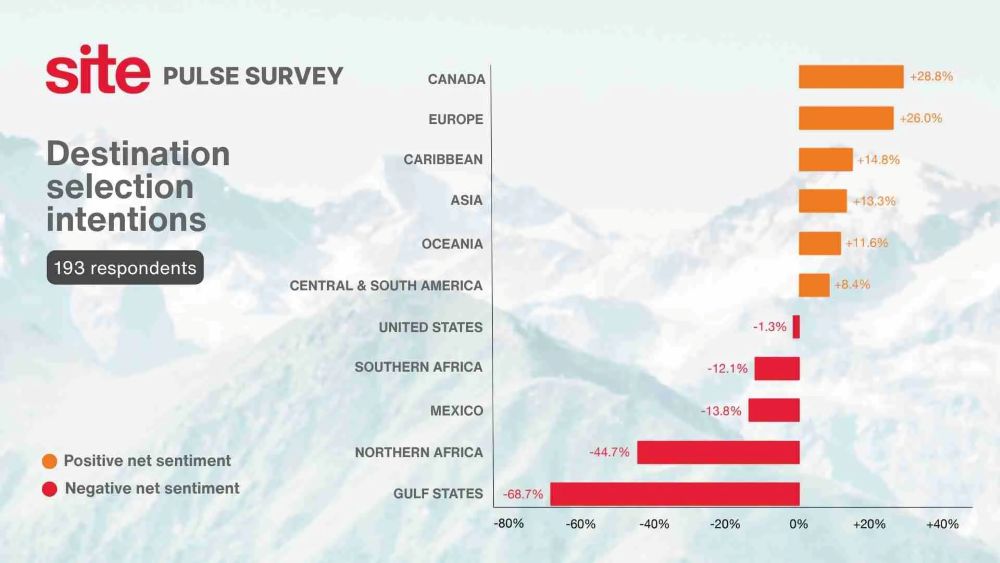
The latest SITE Pulse Survey, conducted among 193 incentive travel professionals, shows how quickly sentiment can shift. Canada emerged as the clearest beneficiary of current market conditions, recording a net sentiment score of +66.7% among European respondents and +46.4% among Rest of World respondents. It also remained positive among U.S. respondents, at +15.1%.
At the other end of the scale, the Gulf States saw the sharpest decline in confidence, including -82.1% among U.S. respondents and -72.4% among Europeans. The United States presented a more mixed picture, with U.S. respondents positive about domestic programs but non-U.S. respondents negative toward programs within the U.S.
For buyers, the message is not that demand is weakening; it is that demand is reallocating. Incentive travel remains resilient, but destination choice is now being shaped by perception as much as product. Safety, stability, values, accessibility, political context and emotional confidence sit alongside hotels, venues and cost.
That matters because incentive travel is never just a trip. It is a visible expression of what an organization values. The destination selected for top performers sends a signal to participants, leadership teams and the wider workforce. A program must be memorable, but it must also be easy to explain, defend and align with company culture.
This is why buyer due diligence needs to go beyond the traditional checklist. Risk assessment remains essential, but it should be paired with sentiment assessment. How do participants feel about the destination? How does leadership perceive it? Are there reputational sensitivities? Is the local community welcoming? Does the destination story support the purpose of the program?
[Related: Incentives Today, A Biannual Publication Produced in Partnership With SITE]
Resilient, Responsible and Rooted in Place
The supplier relationship is also changing. A new SITE Pulse Survey on DMC selection, based on 286 industry professionals, shows that buyers and partners continue to place the greatest weight on human expertise. Across the full sample, local expertise and authentic insight ranked highest, narrowly ahead of reputation and relationships. Responsiveness and agility, together with service breadth, creativity and customization, formed a second tier. Technology and scale sat near the bottom.
That finding should reassure buyers. In a period of uncertainty, the strongest partners are not simply those with the biggest footprint or the most polished systems. They are the partners who know the destination intimately, understand local culture and logistics, have trusted relationships on the ground and can adapt quickly.
For corporate and agency buyers, this puts renewed importance on partner selection. The right DMC is not an order taker. The right DMC is a strategic adviser who can interpret local conditions, manage risk, design authentic experiences, identify community connections and create moments that feel specific to the audience.
The opportunity for buyers in 2026 is significant. Uncertainty can narrow choices, but it can also reveal new ones. Destinations perceived as stable and aligned with client expectations are gaining ground. Fresh formats, emerging destinations and more intentional program design can help organizations deliver incentives that feel relevant to today’s workforce.
The state of incentive travel is not cautious. It is more thoughtful, more human and more strategic. Buyers are still investing in travel as a powerful tool for motivation, recognition and performance, but they are expecting every element of the program to work harder.
The best incentive experiences today will be memorable, but they will also be responsible, resilient and deeply connected to place. For buyers, that is the new standard.
To view other SITE Pulse Surveys, visit SITE's website.