
It might be a terrible pun, but it’s true: In 2025, Amex GBT Meetings & Events had one of its most eventful years ever. The September purchase of rival business-travel and events agency CWT grew Amex GBT M&E to more than 2,300 employees who handle more than 77,000 client meetings and incentives each year.
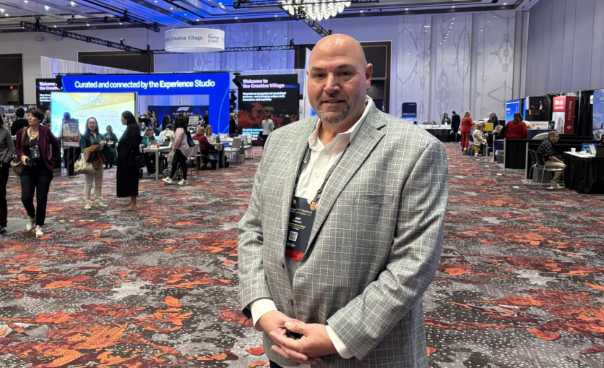
With the buzz from that deal still palpable, more than 1,000 people attended Amex GBT M&E’s annual meeting in early December in Las Vegas. Dubbed Inter[action] 2025, the event saw internal attendance grow 10 percent to 550 planners in light of the CWT deal, while nearly 500 reps from 113 business partners—destinations, hotels, transportation providers, tech firms, and others—filled the exhibit hall at Caesars Forum.
On the final morning of the event, Meetings Today spoke with John Palmisano, senior manager, CES and global strategic events, about how AI played a role in developing many of the activations and experiences for attendees. That initiative was also intended to inspire AmEx GBT M&E personnel to further explore how AI can help deliver more impactful event elements for their own clients.
Jack of All Trades
When asked how AI was being used the most by the company’s planners—for contract building and clause analysis, logistical elements, event design, attendee personalization, event communications, post-event feedback analysis, or for something else—Palmisano said “all of the above. We have a proprietary internal platform called AI Assist that everyone uses regularly, and it is amazing how much more robust it is now compared to when we first started using it. The platform learns from all our input, so it is always getting better.”
According to the 2026 Global Meetings and Events Forecast that AmEx GBT released in October, 50 percent of the 601 responding planners said they were using AI in some capacity on a regular basis, and 34 percent said they were routinely using it to generate creative event concepts and themes.
For Palmisano and his colleagues who planned Inter[action] 2025, that particular objective saw his team begin by using AI to build out attendee personas.
“For both our employees and business partners in attendance, we worked hard on getting their personas finely tuned,” he said. “We asked the usual questions: What are your goals? What are you expecting to achieve on site? What would be a ‘wow’ factor for you? But we also asked personalized questions, such as 'What are your favorite foods and favorite music,’ because we were trying to create strong moments of connection within the event.
“Then we uploaded all that data into AI and asked, What are the common threads among our attendees,” Palmisano continued. “Provide us with a heat map to help us understand what elements we must include on site along with fulfilling their top educational and networking goals.
“In the past, asking so many detailed questions meant you had Excel spreadsheets that took forever to analyze. Now, that analysis takes minutes and gets us moving in the right direction.”
A Roadmap for Users
One thing that Palmisano’s team learned from the pre-meeting questionnaire: Attendees wanted more education about how to use AI to be efficient in all the tasks that planners handle, both the creative and the mundane.
“It was the most popular educational request, so we added more sessions around that and brought in a business partner to help us deliver the education,” Palmisano said. “We saw that people wanted to understand how it can be used best on a daily basis, because it can be so broadly used that sometimes people don’t know where to start. So, we really wanted to educate our teams on how to utilize AI in order to be more efficient in their regular workflow and also to design more impactful events.”