



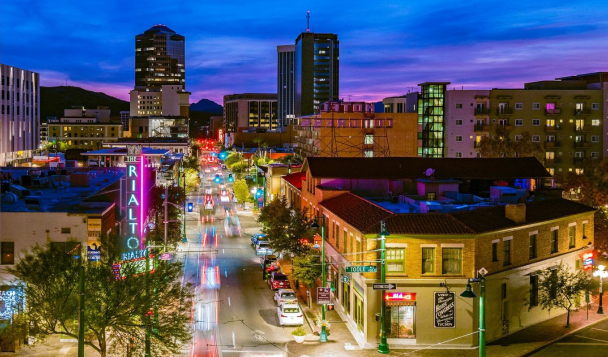
Even without referring to its climate, it’s safe to say Arizona is pretty hot right now.
Since the end of the Covid pandemic, the growth of the corporate presence throughout Maricopa County—with 4.7 million residents across Phoenix, Scottsdale and a few smaller cities—has been extraordinary.
Meanwhile, 110 miles to the south but actually a bit cooler in temperature, Tucson is bustling as a headquarters for mining and heavy-equipment firms as it also leverages the intellectual capital of the University of Arizona for incoming meetings and conventions. And up north in Flagstaff, a different type of meeting experience awaits smaller groups.
Here’s how each destination is evolving to better serve corporate and association event groups.
Phoenix
For meeting and convention business, the blossoming of central Phoenix over the past 10 years cannot be overstated. The combination of corporate growth throughout the Valley of the Sun along with the construction of thousands of apartments downtown has brought a new level of energy and hospitality to the city, including dozens of restaurants, bars (several of them on rooftops) and music venues. These offerings complement various museums and pro-sports arenas around downtown.
With the influx of high-tech manufacturing facilities from TSMC, Intel and Microsoft plus new logistics centers for major companies in various industries, “we are seeing a lot of interest from meeting groups that didn’t really think of us before,” said Lorne Edwards, chief sales officer for Visit Phoenix. That includes SemiCon West, a 20,000-attendee technology show that came to the Phoenix Convention Center this past October—the first time in 50 years the group met outside of San Francisco.
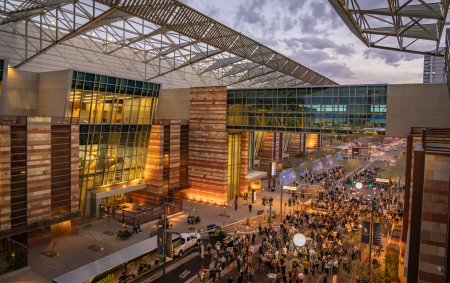
Using the 4,000 hotels rooms located within six blocks of the center plus several others, SemiCon West also took advantage of the convention center’s unique outdoor space that lies between its massive buildings. Known as the Canyon on Third, it’s an 80,000-square-foot street corridor that can be closed off to outside traffic to host festival-style receptions featuring food trucks, bands, backyard games, artistic and cultural demonstrations plus other activations that showcase local talent and flavor. SemiCon’s choice of theme for its Canyon on Third reception: Western Extravaganza.
Another notable element for meeting groups: Arizona State University’s (ASU) Thunderbird School of Management is just three blocks from the convention center; it’s a robust intellectual resource for meetings seeking expert speakers. And ASU’s main campus in Tempe is just five miles away.
[Related: How to Use Low & Shoulder Seasons in Desert Destinations]
Similarly, a deep well of knowledge exists in the city’s life-science sector. “The Phoenix Bioscience Core is a 30-acre campus of healthcare innovation where three Arizona universities collaborate with private industry to solve complex diseases and other healthcare problems,” Edwards noted. “And the Mayo Clinic is presently undergoing a roughly $2 billon expansion of its campus here.”
Partly because of these developments, said Edwards, Phoenix hosted the Association of Diabetes Care & Education Specialists in August 2025 and will host the American College of Chest Physicians this October, both with more than 9,000 attendees.
One other appealing factor for meetings: Phoenix Sky Harbor International Airport is just 3.5 miles from downtown.
Scottsdale
Next door to Phoenix is the resort-heavy town of Scottsdale, which is also seeing more meeting and incentive groups due to the region’s expanding corporate sector, and especially the life-science niche, according to Erika Pumphrey, director of sales for Experience Scottsdale.
As a result, she and many conference sales and service people at Scottsdale hotels and resorts have earned the Healthcare Meeting Compliance Certificate through MPI, deepening their understanding of how life-science events must operate.
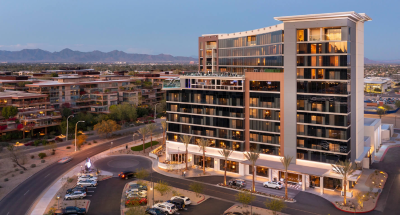
About 18 months ago, the big news in Scottsdale was the opening of Caesars Republic Scottsdale, a 265-unit resort with 20,000 square feet of meeting space including a 7,000-square-foot ballroom, plus social spaces that include a seventh-floor rooftop pool deck and bar. The new-build property is a five-minute walk to Scottsdale Fashion Square’s luxury shops and about a dozen restaurants.
In January, another attraction came to Caesars Republic: the high-end restaurant Wolf by Vanderpump on the 11th floor, with sweeping views of Camelback Mountain.
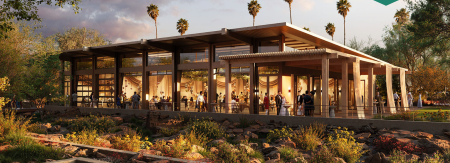
The new year also brought the debut of a transformed property. The former Scottsdale Plaza Resort underwent a full redesign and renovation to become the Kimpton Miralina Resort. The 404-unit property offers 31,000 square feet of indoor and outdoor meeting space, including a stand-alone glass-walled event center with an adjacent lawn.
[Related: Desert Destinations Offer Memorable Group-Outing Options]
Another property reimagination is happening at the 378-room Doubletree Resort by Hilton Paradise Valley-Scottsdale. The renovation will be done by Q2 2026, with upgrades to all guest rooms, food and beverage outlets, lobby and lounge areas as well as all mechanical systems. The renovation also remakes the 40,000 square feet of indoor and outdoor meeting space, including the creation of more event lawns plus expansive presidential suites and two resort-style pools with spacious patios and bar areas.
Tucson
Home to the University of Arizona (U of A), Tucson is also known as a preferred destination for meetings connected to mining and heavy-equipment manufacturing, according to Mary Meade, vice president of sales for Visit Tucson.
“Caterpillar moved its headquarters here about eight years ago,” she noted. “They have a huge testing area nearby and bring in customers from around the world for product demos. We also host a lot of dealer meetings from other companies as well as events run by the equipment-manufacturing associations.
“The university brings in a ton of meetings across its many disciplines, but especially medical events because it has the Andrew Weil Center for Integrative Medicine that focuses on blending conventional medicine with natural solutions,” Meade added.
This fits with Tucson’s 140-year pedigree as a wellness destination due to its dry air and temperate climate—and offers incoming meetings a wealth of interesting speaker possibilities.
Other university assets that could provide engaging presenters are the Richard Caris Mirror Lab, where engineers design and build massive mirrors for ever-stronger telescopes, and the Lunar and Planetary Lab that built spacecrafts that landed on Mars. Also, U of A’s Eller College of Management is a top business school with esteemed faculty.
“There are a lot of very cerebral people here with fascinating stories to tell,” Meade said.
At the Tucson Convention Center, a $100-million renovation was completed two years ago, bringing total square footage to 233,000 and delivering many technological upgrades while adding new outdoor plazas, walkways, water features, sculptures and landscaping.
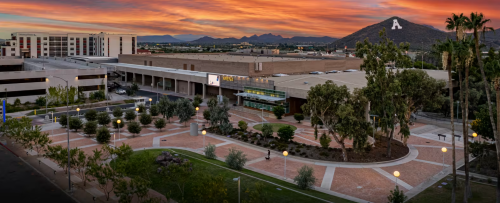
Meade noted that the center’s ideal meeting group would be 500 guest rooms on peak night; the 170-room Doubletree by Hilton is connected to the center, while the dual-branded Home2Suites by Hilton and Hampton Inn offers 199 guest rooms. The upscale Leo Kent hotel has 145 guest rooms and Marriott’s AC Hotel has 128 guest rooms.
Beyond downtown Tucson and near the surrounding mountain ranges are several upscale resorts that cater strongly to meetings and incentives, including El Conquistador Tucson, a Hilton Resort; Loews Ventana Canyon Resort & Spa; JW Marriott Starr Pass Resort & Spa; Miraval Arizona Resort & Spa, by Hyatt; Omni Tucson National Resort & Spa; The Ritz-Carlton, Dove Mountain; Westin La Paloma Resort & Spa; and Westward Look Wyndham Grand Resort & Spa.
Tucson International Airport has direct flights to and from 14 major cities via American, Delta, United, Southwest and Alaska airlines.
Flagstaff
At 7,000 feet of elevation and surrounded by the largest Ponderosa Pine forest in America, Flagstaff is notably cooler than southern Arizona. The town sits just a few miles from Mt. Humphreys, a 12,000-foot peak that gets as much snow each winter as Colorado ski resorts. Just 90 minutes away is the Grand Canyon, making a day trip possible. Another possibility is Sedona, about 45 minutes away.
Flagstaff is home to Northern Arizona University, where forestry, environmental science and engineering are the top programs. On campus, the school’s High Country Conference Center can handle groups of up to 150 and is connected to the 160-room Drury Inn & Suites.
The main meetings hotel in Flagstaff is the 247-room Little America Hotel. There’s 13,000 square feet of indoor meeting and reception space plus a 5,000-square-foot event lawn with a covered stage.
Flagstaff has an artsy, walkable downtown that combines Western and Route 66-themed establishments with laid-back musical and cultural offerings, including a strong craft brewery scene. On the edge of town is the famed Lowell Observatory, where Pluto was discovered in 1930. There, guided tours and night-sky viewings are popular group events.
Flagstaff-Pulliam Airport offers American Airlines flights to and from Dallas and Phoenix. Alternatively, the 145-mile drive to Phoenix’s Airport takes 2 hours and 15 minutes; it’s a routine trip on Interstate 17 for local transportation providers.
Connections
Visit Phoenix
visitphoenix.com
Experience Scottsdale
experiencescottsdale.com
Visit Tucson
visittucson.org
Discover Flagstaff
flagstaffarizona.org