



It’s no secret that in-person meetings cost a significant amount of money. Besides budgeted costs, however, there’s also “opportunity cost” to consider: the loss of productivity and revenue when people leave their daily work environment to attend a meeting.
Sales meetings are prime examples of opportunity cost, making event ROI calculations so important. But right up there with sales meetings are executive retreats, where the leadership team steps away from day-to-day work to identify the organization’s most pressing issues and develop strategic plans for handling them successfully.
The high costs and high stakes of executive retreats put planners in a stressful position. Making things even more difficult is that many retreats actually have a misguided mission, according to Nicholas Gentry, a New York-based keynote speaker, retreat facilitator and professional mentalist for executive audiences.
“I usually get the call from a planner after a retreat’s theme has been set, but it’s often just a vague idea of the direction they want to go—and it often incorporates the word ‘alignment,’” he said. “However, in practice, ‘alignment’ usually signals that there's a major decision that must be made where there are sacrifices and trade-offs connected to every possible course of action, but the organization wants everyone fully on board with whatever course is chosen. Naturally, this results in friction between executives with differing opinions, but nobody wants to say that out loud. So, alignment becomes the goal but it’s probably not what you’re going to get.”
Instead, “a retreat should get executives willing to at least start moving in a particular direction, and leave certain things for later discussion,” he added. “One thing I work hard to get across is that you won’t solve your issues fully at this particular retreat; you're just trying to agree on the best course of action, one problem at a time.”
The Mission and the Approach
Gentry noted that a retreat facilitator often must “thread a needle,” attempting to get everybody in the room to agree first on the problem they are there to solve, and then create a list of all the possible solutions to that problem along with the trade-offs, sacrifices and downsides that come with each possible solution.
From there, the executive participants can debate the severity of each trade-off, sacrifice and downside, then rank the possible solutions based on both their potential benefit and their downside cost.
“My goal is to have participants come up with a thesis statement for a given issue,” Gentry said. “It can have a few clauses in it, but ultimately it should be one sentence: ‘We need to do this because of the following reasons and evidence, which outweigh the countervailing reasons and evidence for these other courses of action.’”
To bring the entire executive team closer to agreeing with the course of action chosen by the final decisionmakers, it’s essential to acknowledge the concerns of dissenters, Gentry stressed.
“The discussion must be deep enough that you can clearly articulate the counter arguments at the end: ‘What would be the best reasons for going in another direction, and why aren't we doing that?’” he said. “This allows the people who think the downsides of the chosen path are significant to see all the input and know in detail why the organization is moving in that direction.
“Acknowledging the merits of opposing views allows dissenters to accommodate the decision in good faith, even if they aren’t fully aligned with it,” he noted.
The Teambuilding Trap
There is, however, another critical factor for getting executives to accommodate a decision they don’t agree with: They must feel that everyone in the room is acting in good faith—for the good of the organization rather than simply for the good of their area of responsibility.
To build such trust, many retreat planners fall back on icebreakers or teambuilding exercises used for other types of meetings. Gentry is dead set against this.
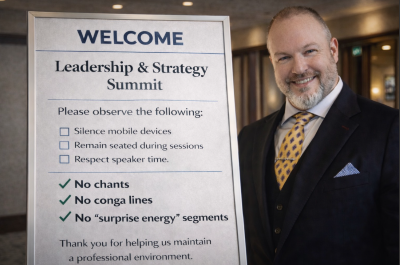
“I often see people hired to lead certain segments of a retreat who are from the ‘kumbaya industrial complex,’ meaning that everything is about a vibe or a feeling,” he said. “I don’t think that executives benefit from surprise ‘energy segments’ or similar exercises. When camp-counselor vibes are misapplied to executive settings, the result is often quiet disengagement.
“These attendees are not their own entertainment. Serious rooms don’t need hype,” Gentry noted. “They need calibration.”
So, although he also entertains executive groups as a mentalist, Gentry takes a deliberate approach with it.
“The concept acknowledges that everyone in the room is extremely intelligent,” he said. “Every part of an executive program should deliver something of value, even the entertainment. After keynotes and breakouts earlier in the day, you can close with a performance that’s not a diversion, but rather a deliberate climax reinforcing the event’s central message."
Building Trust Between Executives
What can be done to get executives in one organization—who are teammates but who compete for organizational resources and must defend their territory and staffs—to trust each other enough to accommodate a strategic decision they don’t agree with?

Adrian Segar, owner of consulting firm Conferences That Work and a 35-year event designer and facilitator, has several trust- and relationship-building tactics he uses with retreat participants.
In fact, he employed them with great success during a 2023 executive retreat featuring more than 40 directors of events from S&P 500 companies, sending them home not only with new, trusted contacts but also with ideas to use during their own company’s executive events.
To foster trust and deeper relationships between executives, “I think it’s critical for people to first reveal something important about themselves,” he said. “Things like, ‘how did you get to where you are—what was the journey? And today, what would you like to learn or achieve from this gathering?’”
Especially when that answer is connected to a specific challenge an executive faces in their work, the next question Segar has participants answer becomes that much more valuable: What is an area or topic where your knowledge would be of value to the other participants?
“For the three questions, I give the group preparatory time to write some things down,” Segar said, “and then everyone gets the same amount of time to speak.”
At the retreat for event chiefs, “pretty much every one of them spoke about something really interesting or innovative they were doing in their work, or something they saw outside their company that they wanted to implement,” Segar noted. “From that, other participants think, ‘Wow, that’s something I want to know more about. I need to engage with that person.’”
Develop Some Sessions Organically
While many executive retreats focus on one or two specific issues, Segar stressed that allowing some time for participant-chosen discussion topics not only strengthens trust but also helps with organizational issues that might be under the radar.
At the event chiefs’ retreat, Segar gave each participant a marker and a few sticky notes, asking them to write down any issues they’d like to discuss with others, either to learn more or to teach others about something they know about.
“We had two time slots open for a few small-group discussions to happen simultaneously,” he noted. “Once people stuck their notes on the wall and we grouped them, it became obvious what they wanted to discuss; the commonalities were strong.”
Participant feedback revealed that “these executives loved the process,” Segar said. “They could express what they wanted from the event, and we made sure to build a supportive structure for that, rather than assuming they'll want to talk about certain things and just having experts who speak on those things. That might turn out to be exactly what your executives do not want. I've seen that happen.”
The Bottom Line
“Retreat planners will be seen as high-ROI employees when the result of their events is useful deliverables that provide executives a clear direction but also recognize that there are trade-offs to account for in that direction,” Gentry said.
“Most big organizational problems are not fully solvable—but they are sufficiently resolvable. As long as you get participants to acknowledge that and act in good faith about it, you’re succeeding.”