



The sustainable-event movement is getting more sophisticated with each passing month. As a result, many corporate and association planners must take time to gather data about their events’ energy usage, water consumption and waste management.
Fortunately, some of that effort can be taken on by other parties. For instance, planners could ask if hotels have the Environmental Protection Agency’s (EPA) Energy Star certification for energy efficiency.
“A venue that tracks its power-consumption data for Energy Star compliance will have monthly usage numbers that planners can use,” said Drew Shula, CEO of sustainable-construction advisory firm Verdical Group. “You can see the property’s historical energy data and probably back out a ballpark number for how much energy your group used.”
Properties that achieve LEED certification for overall resource efficiency are likely to have energy-usage data available as well.
Further, because a hotel’s or convention center’s power source has a notable effect on an event’s carbon emissions, a planner can ask the regional utility company about how its power is derived.
A venue connected to a regional utility whose power is, say, 80% derived from fossil fuels produces significantly more carbon than a hotel whose regional utility uses 40% fossil fuels and 60% renewable sources such as solar, wind, hydro and nuclear. Therefore, carbon-emission measurements from a meeting would have to account for this.
When vetting a facility’s power source during site selection, Julia Spangler, sustainability manager for eco-events firm Honeycomb Strategies, noted that “some utilities are forthcoming about their power sources—called a resource mix or generation mix—while others don't publicly publish it.”
In that case, planners can still get a utility’s resource mix and, in turn, a carbon-emissions figure for a venue. The EPA provides the percentages of each source used by utilities on a state or regional basis at epa.gov/egrid/power-profiler. And California gets even more granular, with data for individual-city or multicity utilities at energy.ca.gov/programs-and-topics/programs/power-source-disclosure-program/power-content-label/annual-power-1.
Here are two useful benchmarks: Overall, 61% of U.S. utility-scale electricity generation comes from burning coal, natural gas and petroleum fuels, which accounts for 855 pounds of carbon emissions produced per megawatt hour. So, any meeting facility connected to a utility using a lower percentage of fossil fuels would produce less than 855 pounds per megawatt hour, and that number can be calculated.
And with more hotels than ever generating their own renewable power, eco-conscious planners can further limit their event’s emissions.
4 Hotels Leading the Way
Hotel Marcel, Tapestry Collection by Hilton in New Haven, Connecticut, is a unique 1970s building of stark Brutalist design. Another standout element: The LEED-Platinum property operates mostly on self-generated solar power, with over 1,000 panels on the roof and parking canopies. An innovative low-voltage power system controls window shades using 30% less power, while electric vehicles have 12 universal charging stations plus 12 more for Teslas only.

The property offers no single-use plastics, and its restaurant and bar compost all their waste. The 165-room hotel with 9,000 square feet of meeting space aims to be America’s first self-powered hotel by the end of 2026.
In Monterey, California, the AAA Four-Diamond Portola Hotel & Spa was recently named the first Surfrider Foundation Ocean Friendly Hotel in Monterey County. The LEED-certified property diverts 75% of its waste from landfills, minimizes single-use plastics and has invested in long-term infrastructure such as a solar-heated pool, an onsite power co-generation system and water-recapture technology in its onsite brewery.
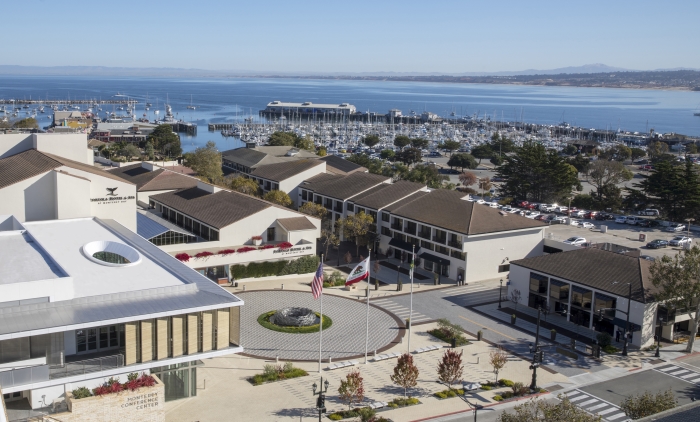
Further, the property has a reduced-waste conference program featuring a customized post-event sustainability report detailing landfill diversion, emissions avoided, water and food saved, and seafood sourcing aligned with Seafood Watch guidelines. The property has 379 guest rooms and 120,000 square feet of indoor and outdoor meeting space onsite and at the adjacent Monterey Conference Center.
Four-Star, Four-Diamond St. Julien Hotel in Boulder, Colorado, is part of the Eco-Cycle Zero Waste program; the hotel composts, recycles or donates nearly 70% of its waste. This amounts to 200 tons of composted trash and 10,000 pounds of donations to local organizations like the Boulder Shelter for Homeless and Resource Area for Teachers.
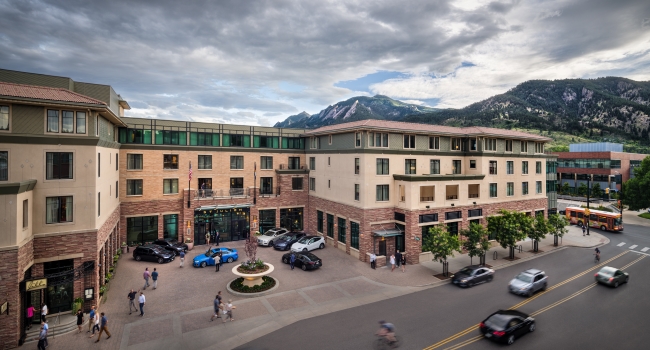
The hotel also partners with Clean the World, which repurposes used hotel soaps and shampoos in hygiene kits for those in need. All bathrooms have Leaping Bunny-certified cruelty-free amenities, and the restaurant’s containers are 100% compostable. The restaurant grows many of its own vegetables, herbs and honey via a rooftop aviary. The property has 201 rooms, 9,700 square feet of indoor meeting space and 6,800 square feet of outdoor space.
At Hyatt at Olive 8 in Seattle, the rooftop gathers Seattle’s abundant rainwater to help insulate meeting spaces, and there’s dual-flush toilets and low-flow plumbing to save 2.4 million gallons of water a year. Rooftop wind turbines generate energy, and usage is mitigated with LED and fluorescent lighting.
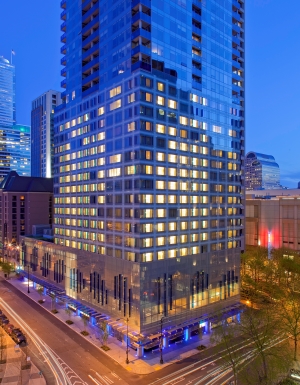 The hotel composts all food waste and donates untouched food to local organizations. Green Key-certified to 5 Keys, the highest level, and with LEED Silver certification, Hyatt at Olive 8 has 346 rooms and 12,000 square feet of meeting space.