


At the close of a successful event, the signs are familiar: half-full serving trays cleared from buffets, boxed meals left behind, untouched platters headed for disposal. For an industry built on precision planning, food waste remains one of its most persistent inefficiencies and one of its greatest opportunities.
Increasingly, meeting and event professionals are being asked to rethink this moment, not just as an operational challenge, but as a reflection of broader priorities around sustainability and community impact.
Insights from the 2025 DNEXT Futures Study reinforce this shift. Produced by Destinations International in partnership with MMGY NextFactor, the study identifies sustainability and community engagement as rising expectations for destinations and the events they host. Planners and attendees alike are placing greater value on experiences that contribute positively to local communities, signaling an evolution in what defines event success.
Food recovery and redistribution sits squarely at the intersection of these expectations.
A Practical Response to a Visible Problem
Unlike many sustainability initiatives that require long-term transformation, food recovery is immediate and tangible. It addresses a visible issue, surplus food, while delivering direct benefits to communities facing food insecurity.
What has historically held planners back is less about intent and more about execution. Questions around logistics, liability and local regulations can make food donation feel complex, particularly in unfamiliar destinations.
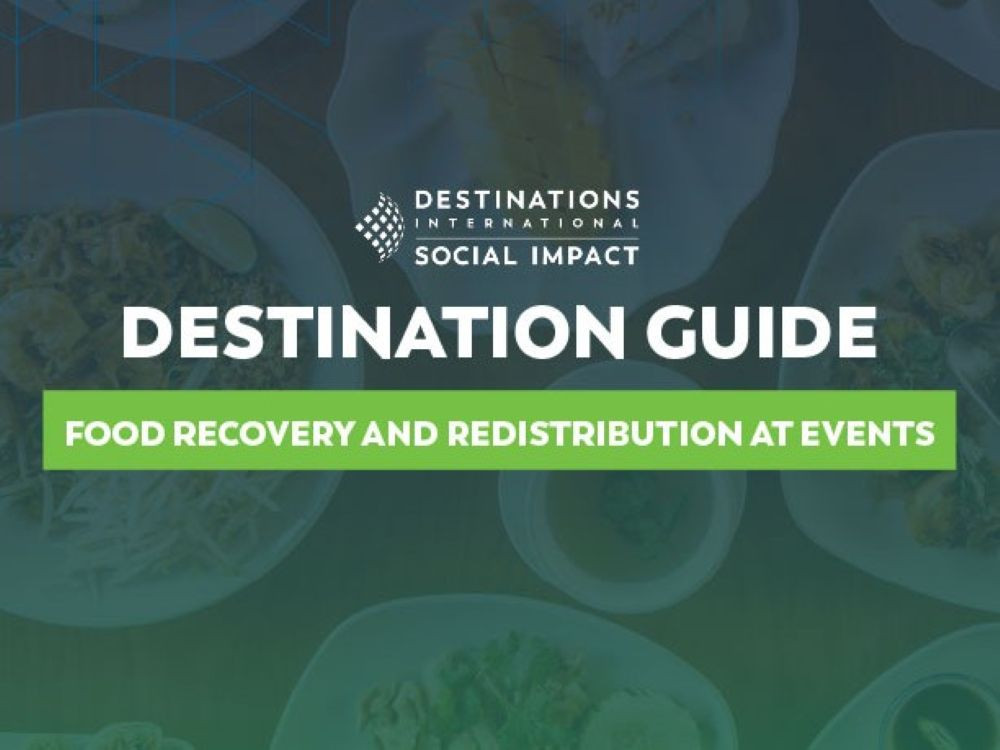
Industry guidance is helping to close that gap. Resources like Destinations International’s Destination Guide to Food Recovery and Redistribution at Events emphasize a straightforward approach: start early, build the right partnerships and embed food recovery into the event plan rather than treating it as an afterthought.
Designing for Recovery
Timing is critical. Food recovery is most effective when considered during early planning, alongside menu development, venue selection and staffing.
This allows planners to address key questions upfront, including venue policies on surplus food, local nonprofit partners, applicable regulations and logistics for collection and transport.
Addressing these elements early helps avoid last-minute waste and creates opportunities to collaborate with partners who can streamline the process.

The Local Connection
The DNEXT Futures Study underscores the importance of community alignment in destination strategy. For planners, this translates into a deeper reliance on local expertise, not only for venues and experiences, but for impact initiatives.
Destination organizations are increasingly acting as facilitators. With connections across hospitality, government and nonprofit sectors, they can help planners navigate regulations, identify credible food recovery partners and coordinate logistics.
This insight is especially valuable given the variability of food donation laws and infrastructure from one destination to another. What works in one city may require a different approach elsewhere.
Addressing the Barriers
Despite growing momentum, concerns around liability and food safety remain common. Yet many of these risks are already mitigated through existing protections and best practices.
In the United States, the “Bill Emerson Good Samaritan Food Donation Act” provides liability protection for donors acting in good faith. Established recovery organizations are also well versed in safe handling procedures, including temperature control, packaging and timely distribution.
Working with experienced partners and following clear protocols makes food recovery both safe and manageable.

Measuring Impact
As sustainability and community engagement move from aspiration to expectation, measurement becomes essential. Planners are being asked not only to implement initiatives like food recovery, but also to demonstrate results.
Tracking metrics such as pounds of food donated, meals provided and waste diverted from landfills offers a clear way to quantify success. These insights can be incorporated into post-event reporting, sustainability commitments and stakeholder communications.
They also tell a compelling story that resonates with attendees, sponsors and host communities.
A Shift in Expectations
Today’s attendees are more aware of the social and environmental footprint of events. According to the DNEXT Futures Study, this awareness is influencing how both destinations and events are perceived.
Food recovery, while often behind the scenes, can become part of that story. Whether shared through subtle onsite messaging or post-event reporting, it reinforces a commitment to responsible event design. For attendees, it adds meaning by connecting their participation to positive community impact.
Redefining Success
Success in meetings and events has long been measured by attendance, economic impact and satisfaction. Those metrics still matter, but they are no longer the full picture.
The growing emphasis on sustainability and community engagement is expanding that definition, prompting planners to consider not just what an event delivers, but what it leaves behind.
Food recovery offers a clear, actionable way to align with this shift. It transforms surplus into support, reduces environmental impact and strengthens connections with host communities.
Increasingly, the most successful events are not only well executed, but also thoughtfully integrated into the places and communities that make them possible.
Sponsored by Destinations International