



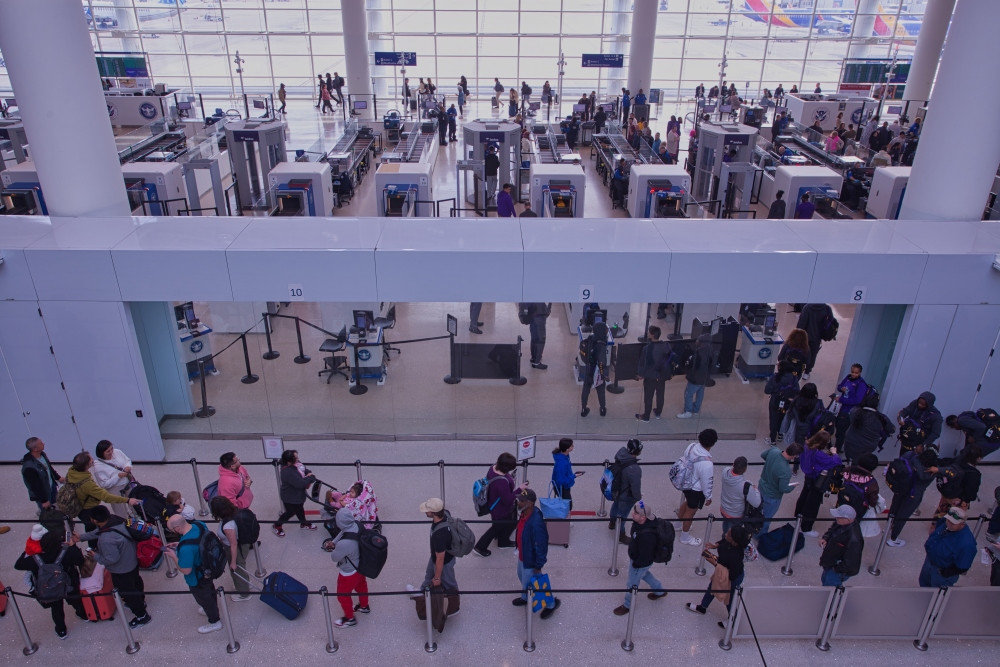
With videos circulating of three-hour-long lines of passengers waiting to move through TSA security checkpoints at several airports, the Trump Administration has followed through on its stated intention to use Immigration and Customs Enforcement (ICE) officers in airport-security roles.
Because federal funding is frozen for TSA agents’ paychecks due to disagreement in the U.S. Congress, callout rates for agents scheduled to work approached 40 percent at several major airports on March 22—day 36 of the funding freeze.
As a result, at least 30 ICE personnel were deployed on March 23 to each of 14 major U.S. airports, including Atlanta, Chicago O’Hare, Cleveland, Houston, New Orleans, New York JFK, New York LaGuardia, Newark, Philadelphia, Phoenix and Pittsburgh.
According to this New York Times article, some travelers were unsettled by the presence of the ICE agents. Tom Charging Hawk, 38, a web developer from Boston, flew into Chicago O’Hare on March 23 to attend a conference and saw ICE agents standing near an exit, but not interacting with travelers. Still, “I’m rattled by the whole thing,” he said, adding that he knew of others who skipped the conference “because of ICE and security weirdness.”
ICE’s Role at Airports
ICE officers were to conduct tasks such as monitoring entry and exit points in terminals so that more TSA agents, trained to handle the machine-scanning and personal security-check duties, could fulfill that duty, according to Tom Homan, the White House “border czar.”
“We’re simply there to help TSA do their job in areas that don’t need their specialized expertise,” Homan said in a statement.
Andre Dickens, the mayor of Atlanta, said in a statement that ICE officers were at Hartsfield-Jackson Atlanta International Airport starting on Monday to conduct "line management and crowd control." He added that agency personnel "indicated this deployment is not intended to conduct immigration enforcement activities."
An unnamed ICE official told NBC News for this March 23 article that ICE officers are not trained to use magnetometers or X-ray machines, but are trained in crowd control, line monitoring and ID checks, making them useful for lines leading to security screening.
Nonetheless, Everett Kelley, president of the American Federation of Government Employees, the union that represents TSA officers, criticized the plan. "ICE officers are not trained or certified in aviation security," he said in a statement.
In one conversation overheard by an NBC News reporter, a flight attendant said to colleagues at an airport gate that she hopes ICE officers don’t create confrontational situations, given that “they’re not trained to have the patience we have in this business.”
At one airport that has ICE officers assisting—Philadelphia—security wait times were reduced to about 30 minutes on March 23. But New Orleans and Houston, where ICE officers were also deployed, still had three-hour-plus security waits, while Baltimore/Washington and New York JFK stopped updating their security wait-time apps, leaving passengers in the dark until they arrived at the airport.
Meanwhile, at some large airports not using ICE officers, wait times on March 23 were not unreasonable: Orlando was 45 minutes, while Charlotte, Denver, Minneapolis and Nashville were about 10 minutes.