



“Just about every week, there's something else in the news that you didn't think about—things that relate to risk management and contingency planning for your events.”
In 2026, that sentiment could come from just about any corporate or association meeting planner—including the planner for the White House Correspondents Association, who saw a brazen gunman rush through the event's entrance inside the Washington Hilton on April 25.
Jeannie Weber, event director and risk-management specialist for 360 Live Media, is the planner who happened to voice that widely accepted thought to Meetings Today recently.
Weber coordinates several association conventions and trade shows each year, trying hard to keep those events from being disrupted by people motivated by international conflicts, domestic laws or government policies, social issues, corporate espionage or simply personal difficulties.
Advance-Preparation Tips
Weber’s job now requires more time spent on coordinating safety and security plans and protocols with a convention center’s internal teams, and with a host city’s police force to some degree as well.
“Several months out, we identify the scenarios we think we should focus on the most and create a core response team among the facility’s safety and security staffs and our staff,” she said. “So, in an emergency, what is the communication plan and who has particular roles and responsibilities? Where are the meet-up points? All this becomes the game plan for how things will happen on site.”

Next, Weber starts a text thread among that team.” I pin it as a favorite in my phone so that it stays up top, and if cell service is not good when you need it, you can still use the thread through the venue’s wifi,” Weber noted. But in case of a deliberate hack, bad weather or other issue that affects cellular and wifi signals in the meeting venue, Weber also provides the team with two-way radios and reminds them to always keep those charged.
“Our last pre-event touch point is to have the center’s security director meet with us once we’re in town, walking us through the venue to go over the security plan for the high-importance areas, who to call, where to get to,” she added. “I find this keeps things top of mind for everyone, because who is going to remember exactly what’s in the 40-page risk-management document?”
One thing that differs from city to city is who controls the sidewalks and shuttle areas outside the doors of the convention center. “Planners need to know this not only for security purposes but also in case there’s snow; someone needs to clear and salt those paths,” Weber said.
Inside the center’s doors, an event host could opt to have uniformed police officers visible in registration areas and as people approach security checkpoints and badge scanners at the hall entrance. “That could act as a deterrent [to bad actors] and also give attendees a sense of comfort,” Weber noted.
Interestingly, some technology tools employed at convention-center security checkpoints have improved thanks to AI, becoming less intimidating and time-consuming yet possibly more effective.
Case in point: Legends Global, which manages more than 80 convention centers in North America, uses security firm Evolv to check attendees for weapons not with a traditional metal detector but with inconspicuous floor mats. These high-tech mats can determine shapes of objects in attendees’ clothing and bags, then use AI to instantly compare those shapes to all types of potential weapons.
[Related: Behind the Scenes: Massive Convention-Security Drill in Orlando]
“We're accustomed to going into concerts and sporting events with our clear bags and walking through a magnetometer,” said Anna Nash, senior vice president, market development for Legends Global. “But this makes the process more subtle; you're probably not even aware that you're walking over something that’s for security. We’re bringing that technology from our stadiums, arenas and theaters to our convention centers.”
“I think that could be a good option, because you don’t want your attendees waiting in line to go through metal detectors if they don’t have to,” Weber said.
Using Eyes in the Sky
Since 2018, the Society of Critical Care Management (SCCM) has maintained the quality of experience for nearly 6,000 attendees of its annual Critical Care Congress by using more than 20 iPhone cameras mounted on tall poles in the corner of the ballroom, the breakout rooms, prefunction areas, exhibit hall, registration area, and entrances to their event space.
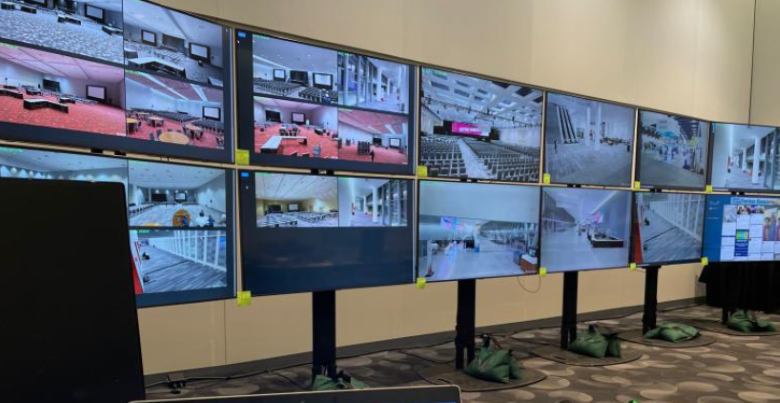
A team of planners, vendors, and security personnel oversees the entire meeting from a room with video monitors connected to those cameras. And on the show floor are more than 60 staffers who can contact the control room whenever something needs attention in a given space.
Using the video monitors, the observing managers can locate that problem and send the right person—from the planning team or from catering, audiovisual, exhibitor services, building operations, or security—to remedy it.
In 2023, a frightening incident suddenly changed the mission of the surveillance from quality control to crisis management. Critical Care Congress was happening at a major West Coast convention center, and in the late afternoon of one conference day—after sessions had ended but with a few hundred attendees still milling around—“we saw on the monitors some unusual activity in the center’s main lobby,” said Ariel Litewka, senior meetings manager for SCCM at the time who is now with the American Society for Surgery of the Hand. “Some of our staff were gathered at the center’s front doors, keeping attendees from going outside.”
Just then, a team member in the lobby notified the control room that city police had closed the street and were looking up at the front of the glass-walled center. A minute later, “we got word that there was someone [on the building’s exterior] and possibly moving towards the roof,” Litewka recalled.
“Our first thought was, ‘Is it someone who wants to harm our attendees?’ There’s an outdoor terrace on the second floor with doors that might have been locked, but we just didn’t know. So, our focus turned to getting our people out of the meeting spaces and down to the lobby.”
In that moment, the cameras in breakout rooms and prefunction space on each floor became most valuable. “Because we could see the entire third floor was empty, we didn't have to send anyone there,” Litewka said. “On the second floor, we saw a few rooms with people in them, so we sent a security guard to bring them to the lobby. We got everyone out of the building within 10 minutes.”
A few minutes later, SCCM’s control room received an update directly from city police: A mentally disturbed person had climbed up the side of the center’s two-story welcome sign, then leaped to a second-floor ledge on the building. However, the person had been apprehended and the situation was over.
“My biggest takeaway was how well our system let us handle that emergency,” Litewka said. “It allowed us to get the information we needed and to respond in that moment.”
Other Smart Security Tools
For its 2024 RiskWorld conference, the Risk and Insurance Management Society (RIMS) bolstered its safety and security blueprint after an active-shooter situation occurred about a mile from its 2023 convention. First, RIMS added metal detectors plus a few K-9 police patrols at the center’s outdoor entrances. Pre-show communication prepared attendees for these elements.
In addition, Stuart Ruff-Lyon, chief commercial officer for RIMS, implemented a tech application named Gabriel that enables a virtual command center that’s connected to on-site cameras. Gabriel can be accessed from team members’ mobile phones, while its emergency-alert function can be accessed via phone by event participants, in addition to physical buttons on kiosks set in various spots throughout the show.
The tool can detect unusual loud noises and sudden high-energy behavior, including personal confrontations, across the event space. If an incident occurs, Gabriel can determine the exact location and focus several cameras on the area, while alerting police or medics and sending a mass notification to attendees about areas to avoid.
Ruff-Lyon also built a command center, relying mostly on traditional radios rather than phones to guarantee signal reliability. “We were thinking about an earthquake or a hack or other sabotage where we lose cellular service,” he says. “All security and other key vendors are on radio with us.”
After the 2024 event, RIMS partnered with ASIS (the largest international association for security professionals) and the American Society of Association Executives to create an event risk-management toolkit that’s available to all planners.