



In March, Meetings Today conducted a survey of 70 corporate, association and independent planners attending a webinar on event contracts. The question: Which area of contract negotiation is most difficult and time-consuming for you?
About 33 percent cited attrition allowances and minimum room-pickup percentages, while another 32 percent cited the financial penalties related to attrition.
No surprise there.
However, another 26 percent of responding planners said that negotiating audiovisual and production terms and rates with a host property was even more difficult than attrition-related issues. And if the recent planner chatter on social media is any indication, this element of meetings is only becoming more tricky, even for seasoned veterans.
Case in point: “At a recent Advanced Planner Roundtable of Meetings Professionals International’s Washington State chapter, audiovisual costs were [cited as] the #1 pain point,” noted John Chen, CEO of event consultancy Conference Rescue, in a March LinkedIn post.
Of all the elements related to coordinating business events, AV and production is generally where most planners have the least understanding.
“I love working with the planner community, but many of them are not sufficiently savvy on the business side of AV,” said Scott Frankel, president of event-production firm Animatic Media and founder of the Event Pro Institute, which administers the Meeting Professional Audiovisual Certificate program.

From the planner’s perspective, “you’re on a site visit a year out and you like the hotel’s space, the F&B offerings, the room rates, and you’re excited to sign that contract before you go home,” Frankel noted. “However, use every ounce of restraint to not sign until you have all the information about the rates and terms coming from the in-house AV company, even if you plan to use your own AV partner. The numbers involved are too large to not know the fine print and negotiate as much as you can before signing.”
From another perspective, “the goal with AV and production should not always be to spend as little as you can, but to extract as much impact and experience from every dollar you do spend,” said Jim Russell, the new global head, business events services for Maritz who spent 36 years on the AV and production side with Freeman and, before that, PSAV (now Encore). He’s also the current chair of the International Board of Directors for MPI.
“AV should not be seen simply as a cost center,” Russell added, “but rather as a performance lever for the objectives you are trying to accomplish at a meeting.”
[Related: Take our latest 4-question survey on AV/production costs and hassles]
Where to Start
To ensure that AV and production stay on budget, it’s imperative to conduct a needs assessment before the planning process starts moving. In short, planners must match the goals of each part of an event with the right AV and production elements.
For educational sessions, “if you going to have many breakout rooms in addition to the main session in the ballroom, you really have to get your equipment needs right to stay on budget,” Frankel said. “You might have a couple of panel discussions with Q&A that need a lot of microphones, and in other rooms have straight presentations where session leaders use laptops and need podiums and screens as well as tech support for audio. Failing to account properly for what you need means either a compromised experience or exorbitant last-minute charges.”
[Register for our upcoming webinar: Event AV & Production: Delivering Impact While Staying on Budget]
Then, for the keynote sessions, entertainment interludes and award ceremonies happening in the ballroom that need heightened sensory experiences, “it’s about how you can use the equipment to give a different experience for each,” Frankel noted. There are smaller decisions to make as well, but they can still be costly. For instance, “Are you planning on doing crowd interaction with a camera? A camera can cost $1,800 a day, so you’ll have to build that in and maybe trim somewhere else.”
Russell summed it up this way: “Great production does not have to be expensive, but indecision will always be expensive. The more nebulous you are at the start of planning, the more variance your budget will have as the process moves along.”
Use an In-House or Outside AV Firm?
With a needs assessment in hand, planners can obtain a price estimate from a hotel’s in-house AV provider, and then compare that to quotes from outside AV firms.
At this critical moment before the event contract is signed, there are a few things to consider. For one, “there’s a revenue-sharing agreement between the in-house AV company and the hotel that might be as much as 50 percent,” Frankel said. “So, if your event is coming in the off-season or doing a lot of F&B on property, there’s negotiability on in-house AV rates and perhaps rigging, electrical and internet. The hotel could give up a portion of its revenue share to make things work.”
This is also the time to negotiate for some veteran techs to run the program, not mostly newer techs with less training and troubleshooting experience.
[Related: More Articles on Contracts from Meetings Today]

If the in-house firm’s quote is acceptable, there are some benefits to using them, according to Russell. “In-house people know the ins and outs of that facility, and what’s worked well there before,” he said. “And it’s amazing how much a hotel’s banquet team will help out if you’re using the people they know versus outside people.”
On the flip side, using an outside AV company has some advantages beyond pricing, especially if a group has history with the firm that makes it easier to match event objectives with the AV and production experience.
In addition, “outside providers are bringing in equipment specific to that group’s needs, whereas the in-house provider is trying to use its onsite equipment to fulfill every group’s needs,” Russell noted.
When planners opt to use an outside firm, though, it is essential to obtain the “AV service standards” or “production guidelines” document from the host property. That’s where planners will find the requirements and fees for shadow labor/in-house supervisors, audio and video patches, electrical, rigging, internet plus all other stipulations around using an outside AV provider.
“The property is not going to give you this document before signing the contract unless you ask,” Frankel said. “Too many planners get it a month afterward and are locked into those terms and rates, which are different than if you used the in-house provider.”

Marianne Shane, vice president, national sales for Orlando-based Audio Visual One, has recently found charges for podiums in these documents, along with requirements for multiple load-in/ load-out supervisors to oversee the outside AV firm. “Don’t agree to more than one supervisor,” she advised. “You often don’t see them anyway.”
Then again, Russell said that planners can tap into the property knowledge of that supervisor to benefit their program, “especially if the person knows that certain rooms don’t combine well with a sound patch, and things like that.”
Lastly, Shane stressed that for meetings taking place beyond 2026, the contract should specify the percentage increase that will apply to the AV rates, based on today’s rates.
Bang for the Buck
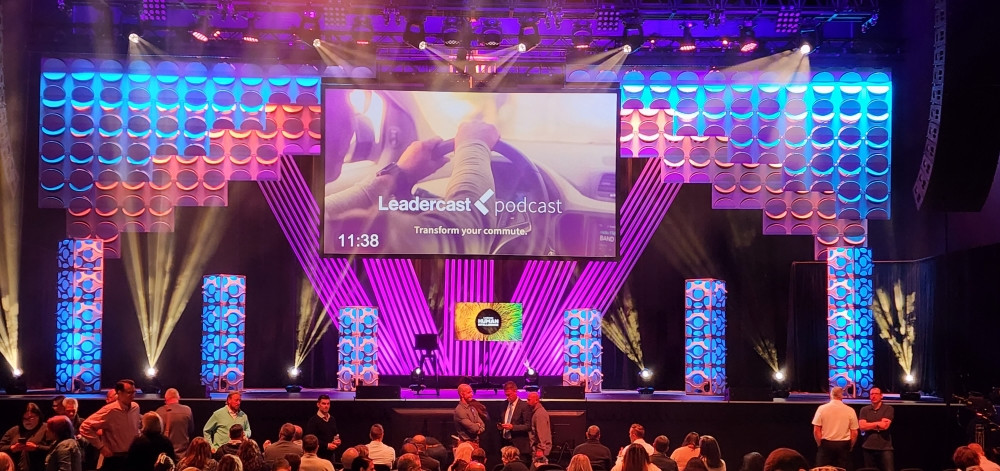
Planners who don’t have a low-six-figure AV/production budget for their events can still create main-stage sessions that deliver strong impact. For instance, combining screen projection as a backdrop with vertical LED boards set at different angles and depths on the stage bring interesting visual options, while directional and surround audio is affordable because ever-smaller equipment makes rigging easier.
However, “the biggest thing for making an impact at favorable cost is lighting,” said Mason Freitas, a veteran production specialist for AVL Solutions in Greenville, S.C. “If you want people to be wowed the moment they walk into the room, it's usually lighting that will do it.”
“Lighting changes the environment, even if you have LED walls up on stage,” he added. “If you put color and haze throughout the room, you're creating a lot of accent and texture. Without different lighting, even LED walls can lose their impact. Using lighting to transition to different segments makes a difference.”
Maritz’s Russell agreed. “Lighting is relatively inexpensive to hang. You can use the same scenery, but lighting variety creates new atmospheres and moods. Also, different colors complement specific learning objectives and retention.”
Russell also favors either live or artificial greenery along the front of the stage, around LED panels and elsewhere. Besides providing different looks under different lighting, greenery can also hide on-stage light sources.
While holograms have gotten a lot of recent attention, Russell said that “they can be expensive, and I’ve heard some feedback that audiences find it a bit gimmicky with keynote speakers.”
For a rousing closing segment, though, using holograms to entertain the audience is becoming more common. In fact, Frankel used the technology during the Catersource + The Special Event show earlier this year.
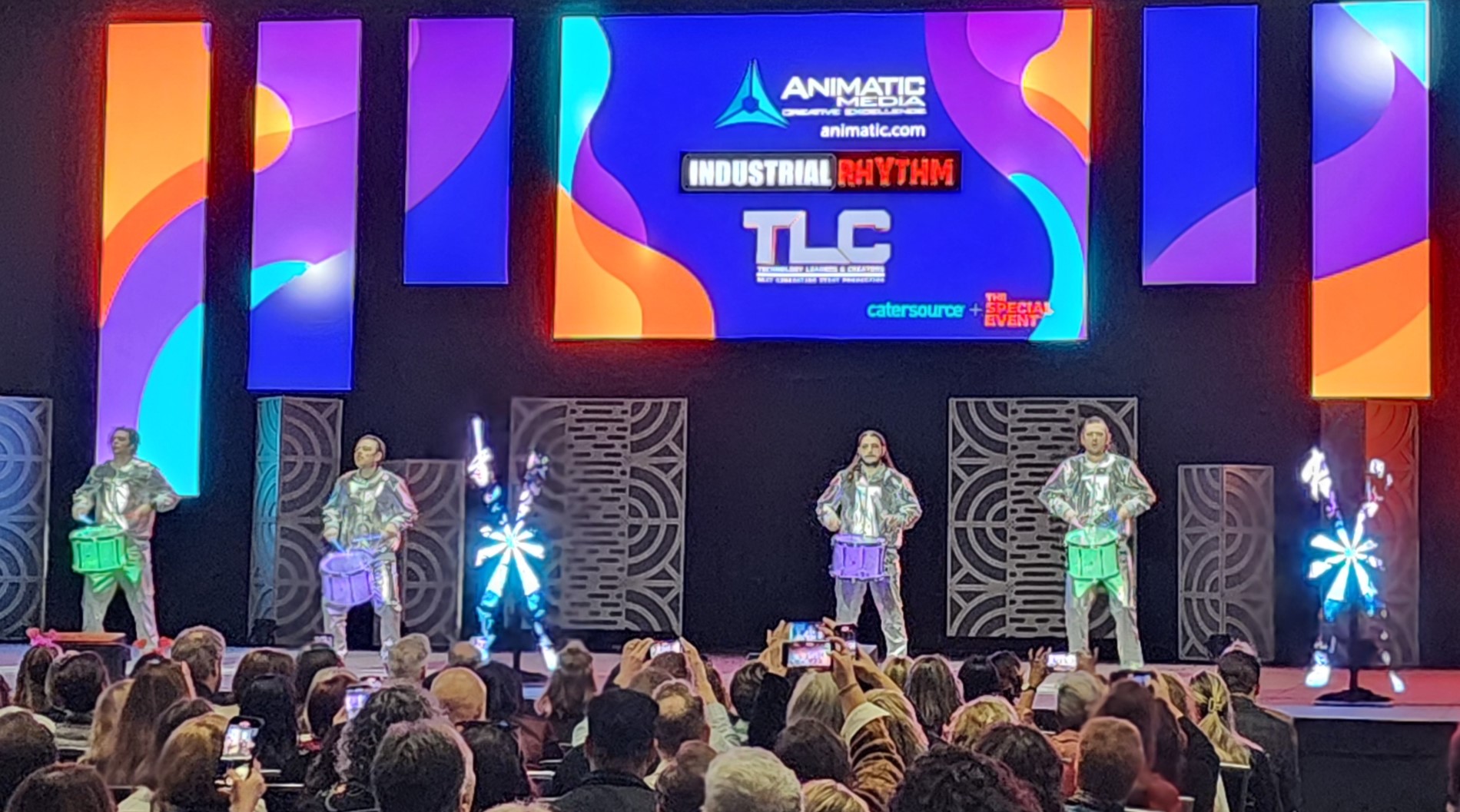
“We had six drummers on stage, but three were in person and three were holographic,” he said. The in-person drummers wore black clothes with LED lights as piping, interacting with the three holographic drummers by taking turns performing. “It was really interesting and the crowd loved it.”
There’s one caveat, however: “This type of thing needs a professional producer, because if you do it wrong it will fall flat and you’ve wasted a lot of money,” Frankel said.
If holograms are out of budget range, Russell pointed out an old-school alternative for generating objects that float above and around a keynote speaker: Pepper’s Ghost.
An optical illusion that uses a transparent glass or plastic surface set at a 45-degree angle to reflect a hidden, brightly lit object or person, Pepper’s Ghost makes them appear as floating, semi-transparent objects. It relies on controlled lighting—brightening the hidden object and dimming the stage—and a proper angle of reflection.
“Business events still use Pepper’s Ghost because it can be very effective,” he said.
The Final Element: Rehearsal
For all the money and effort that goes into AV and production for business events, it’s shocking how often key players do not attend the on-site rehearsal.

“If your general sessions have a lot of moving parts, there needs to be a walk-through, at least for the main players,” Freitas said. “A lot of people aren’t familiar with teleprompters and microphones, and they aren’t smooth with transitions. They have to know their path to the stage and where they will stand or sit so things aren’t awkward. Along with lighting, a good emcee plus executives and keynoters who have rehearsed are really important to the experience.”
“Rehearsal is also for the production team to get familiar with presenters and slides, entry/exit transitions and timing of music,” Russell added. “We’ve all sat in events where things felt uncertain and the timing is off, and it detracts from the message you’re trying to get across.”
“The audience experience is very much enhanced with a rehearsal, and executives have to plan their travel to allow for that.”
-- -- -- --
The High Cost of Inexperience
Over his 30-plus years in the business, Scott Frankel has seen many mistakes by planners as they negotiate with an in-house AV provider. Sometimes, those mistakes can cost more than just money—a planner could face career damage when a lack of AV/production knowledge results in a blown budget.
Two examples from Frankel:
• A planner who had budgeted just $3,600 for internet service in the meeting space for a three-day event greatly underestimated how much bandwidth would be necessary for the program and for attendees. The result: A last-minute revision of service that brought the final cost to $18,000. As a result, an evening party had to be cut from the event’s agenda while on site, to the chagrin of attendees and executives alike. After the event, the planner lost some responsibilities.
• A planner who had come up through the ranks of her company’s meetings department was placed in charge of an event for the first time. While she had handled some of the event’s elements in the past, she had never dealt with its AV/production requirements and contracting.
As a result, “the request for proposal she sent to the host hotel’s AV provider far underestimated what the event would need,” Frankel recalled. “For instance, she did not mention needing audio in the breakout rooms; did not mention that presenters would be using their own laptops and needed a switcher device along with a tech person for that; did not account for any video engineering; and had a few other oversights.”
Even worse, “the AV company did not ask her a single question,” Frankel noted. “They simply provided a quote for what she submitted without any consultation about the event’s needs.”
In the end, the original $45,000 quote for AV/production became an $82,000 final bill—and the planner was fired.
-- -- -- --
Digging In With Their Clause
Here are two examples of why planners should read AV-related clauses closely and obtain the “AV service standards” or “production guidelines” document before signing a meeting contract—and then be prepared to negotiate certain elements out of the contract or walk away from the deal.
• At least one hotel with a nationwide AV company in house has used the following clause in proposed event contracts:
“Should client elect to receive bids from other purveyors for its audiovisual requirements, [in-house firm] will be given first right of refusal to match the initial written proposals (to be provided by client) and, if matched, [in-house firm] will be awarded the bid. Should [in-house firm] be unable to match an offer and outside audiovisual services are used, client will be responsible for technician fees for time spent with client’s audiovisual company. Client will also be responsible for all fees associated with power and audio patches. Please refer to the Event Technology price guide for minimum hours and pricing.”
In short: The event host would not be free to use a production partner of their choice, unless the outside firm’s quote was unreasonably low.
• A few years back, a major hotel on the Las Vegas Strip had in its event contracts that groups using an outside AV company must provide the hotel with a list of gear being brought in. The hotel would then charge a “corkage fee” equal to half of their regular fee for that gear. Because the in-house prices for such gear were far higher than those of the outside firm, the group would essentially be paying double for using outside gear. Some larger groups were able to negotiate the fee away.