



Several of my clients have started telling me that their customers are finding them in a new way: They’re being recommended as an answer in an AI engine. Someone asked an AI engine a question, and my client’s name came back as the answer. They weren’t discovered through a Google search or a LinkedIn browse. Those steps, ones we have long considered among the first to take in finding and connecting with colleagues, are now follow-up steps as more users turn to AI first.
LinkedIn has become one of the most cited professional sources across every major AI platform. When someone asks an AI engine to recommend a corporate event planner or conference producer, it pulls from sources it trusts. LinkedIn is near the top of that list.
That means the conversation about your professional reputation has moved. It’s happening inside AI engines before anyone visits your profile, before anyone searches for you directly and often before they’ve decided they even need someone like you.
The question worth asking today is not whether people can find you on LinkedIn; it’s whether AI can find you, understand what you do and include you in its answer.
[Related: How to Write Comments That Get You Discovered on LinkedIn]
Your Profile Is Now an AI Source Document
AI engines read LinkedIn profiles the way a researcher reads a reference document, scanning for signals: What does this person specialize in? Who have they served? What outcomes have they produced?
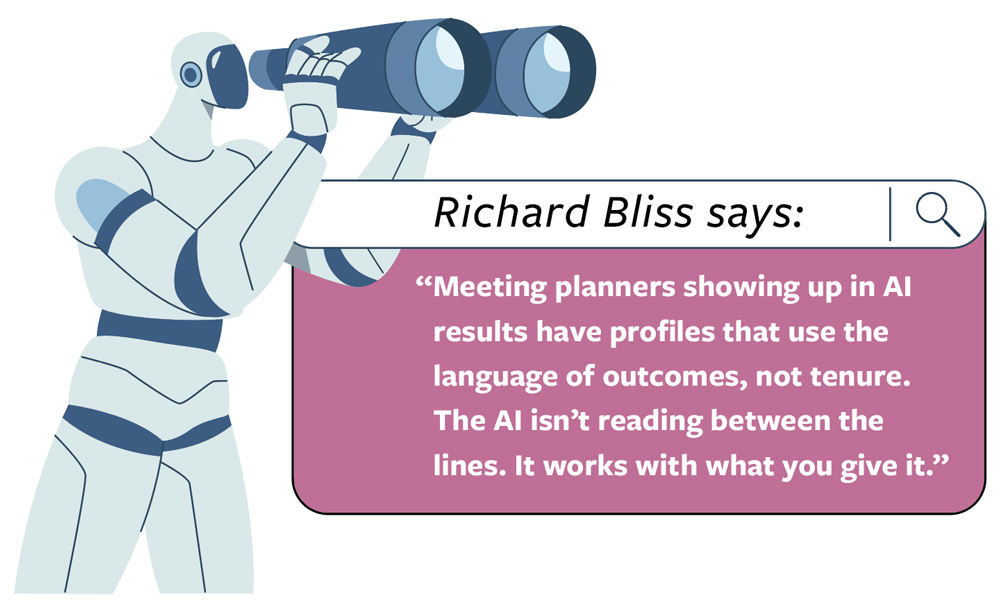
A LinkedIn headline such as “experienced meeting planner with 15 years in the industry” tells the AI you exist. It does not tell the AI what problems you solve or why you’re the right answer to someone’s question or needs. Meeting planners showing up in AI results have profiles that use the language of outcomes, not tenure. The AI isn’t reading between the lines. It works with what you give it.
The Specificity Problem
The most common mistake I see on LinkedIn profiles is vagueness. A headline like “full-service event planning and management” could describe almost anyone in this industry. AI engines are looking for specificity because they’re trying to match you to a specific question.
Think about what a client might actually ask an AI engine: “Who specializes in incentive travel for pharmaceutical companies?” If your profile doesn’t contain examples of you talking about, commenting on and creating content around your specialty, the AI cannot connect you to the question, no matter how qualified you are.
Your profile needs to contain the language your ideal client would use to describe what they need, not the language you use to describe what you do, and not a list of keywords.
[Related: Here's Why Planners Should Post Comments on LinkedIn]
What to Change This Week
If you want AI to find you via LinkedIn, here are four places to start.
First, your headline. Rewrite it to name your specific client and the outcome you deliver.

Second, your About section. Open with the problem you solve. The first three sentences carry the most weight with AI systems.
Third, your recent content. One focused post a week about what you do best outperforms three posts a week about everything.
Fourth, write long-form articles. Of all content types on LinkedIn, articles carry the most credibility weight with AI engines. A 500- to 800-word article on a topic you know deeply does more to establish you as a credible source than a dozen short posts. AI treats depth as a signal of expertise that short-form content simply cannot replicate.
The professionals treating their LinkedIn profile as an AI source document are positioning themselves for what’s already happening, and because of that, AI will position these professionals as solutions.
Connect with Richard on LinkedIn.
Read more LinkedInsights content from Meetings Today