
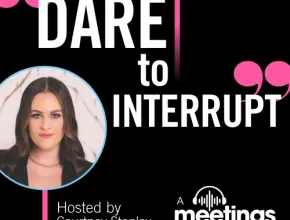
The Growth Edge: Making Bold Moves Before You Feel Ready
Season 7, Episode 4
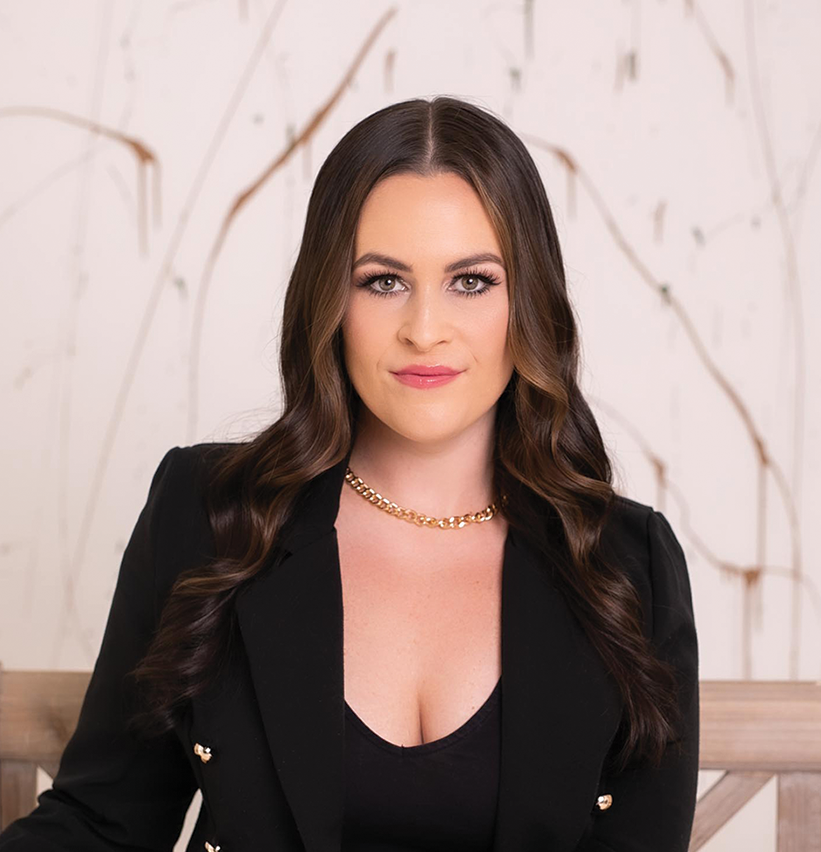
Guest: Carly Silberstein, Event Entrepreneur, Cielle & Co.
Carly Silberstein, event entrepreneur at Cielle & Co, joins host Courtney Stanley for a conversation about what it takes to build, evolve and lead in a rapidly changing events industry.
Together, they explore why some of the biggest opportunities come before you feel ready, how Carly is investing in the future through event technology and emerging talent, and what it means to make bold, aligned decisions about where to focus your time and energy.
They also unpack the realities of navigating growth, making high-stakes decisions and stepping into what’s next with clarity and conviction.
Listen now:
Listen to more Dare to Interrupt podcasts: MeetingsToday.com/Dare-to-Interrupt.
Podcast sponsored by Myrtle Beach Convention Center.

Meet Our Guest:
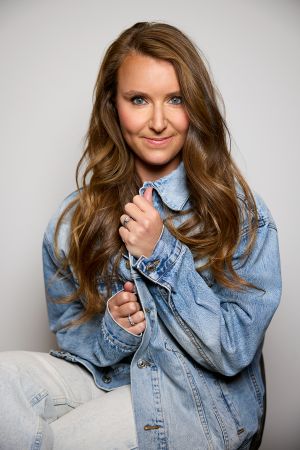 Carly Silberstein is a serial entrepreneur recognized for pushing boundaries in the events industry.
She is the Big Idea Award winner at the Canadian Meetings + Events Expo (2025) and the recipient of the MPI Toronto President’s Award (2026). She is the co-founder and former CEO of Redstone Agency, where she built one of Canada’s leading event and association management agencies.
Today, Carly leads new ventures through Cielle Group—a modern holding company focused on investing in and scaling businesses across the event ecosystem—and delivers consulting, event management and strategic services through Cielle & Co, its operating arm.
She is also the first outside investor and fractional CRO of shutterb, a Canadian event technology startup that connects event hosts with talented smartphone content creators.
Carly is passionate about building companies at the intersection of events, experiences and technology, and is known for driving growth, fostering meaningful partnerships and shaping the future of the industry.
Connect With Carly:
LinkedIn
Instagram: @carlysilberstein
Website
More About Our Host:
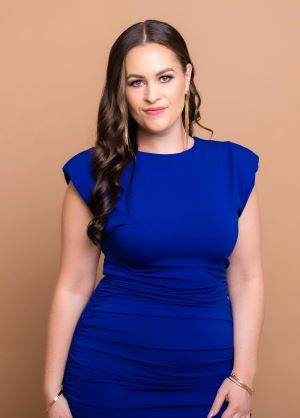 Courtney Stanley believes that transforming past experiences into impactful conversations through raw, authentic storytelling challenges the status quo, connects people from all walks of life and results in great change for the world.
Courtney is the youngest member to have ever been elected to Meeting Professionals International’s (MPI) International Board of Directors.
She is the recipient of Smart Meetings’ Entrepreneur Award, MeetingsNet’s Changemaker Award, the Association for Women in Events (AWE) Disruptor Award, the MPI Chairman’s Award and MPI RISE Award.
She was also named Collaborate and Connect Magazine’s 40 under 40 and a Meetings Today Trendsetter.
Recognized as one of the event industry’s most impactful change-makers, Courtney serves on the Events Industry Sexual Harassment Task Force, AWE’s Board of Directors, MPI’s Women’s Advisory Board, is a Meetings Mean Business Ambassador and is the co-founder of the award-winning movement, #MeetingsToo.
Courtney was named as a 2020 Meetings Trendsetter by Meetings Today.
Connect With Courtney:
Website
LinkedIn
Instagram: @courtneyonstage
Twitter: @courtneyonstage
Facebook
Transcript:
Editors note: The following transcription was facilitated by AI program Otter.ai and proofed by our editors. Although it is fairly accurate, there inevitably will be some mistakes, so please consider that when reading. Thank you.
04-20-26-D2I
Tue, Apr 14, 2026 2:13PM • 40:53
This episode is sponsored by the Myrtle Beach Convention Center.
Courtney Stanley
Welcome back to the Dare to Interrupt the podcast, where we have honest conversations about leadership, ambition and what it really takes to succeed in today's world.
I'm your host, Courtney Stanley, and today I'm joined by Carly Silberstein, event entrepreneur, founder of Cielle & Co, and a leader shaping the future of the events industry through innovation, investment and bold decision making.
In this conversation, Carly shares what it looked like to step away from the company she spent a decade building, and how that decision became a return to herself. We talk about betting on what's next, from investing in event technology to building the future talent pipeline of the industry, and why some of the biggest career opportunities come when you may not feel ready.
If you've ever questioned your next move, or whether you're ready to take a leap, this one's for you. Let's dive in.
Welcome to the show. Carly, what's bringing you joy right now?
Carly Silberstein
This conversation same and hearing you and having this moment with you. I agree. Just girls who gab, you know, and take over the world one industry at a time.
Courtney Stanley
Love it. So I actually love the timing of this episode, because it's what almost exactly a year ago to date, that you made one of the biggest decisions of your career, which was stepping away from this incredible agency that you spent a decade building. Can you take us back to the beginning of that journey and walk us through how you got to where you are today?
Carly Silberstein
Absolutely, thanks for the great, thoughtful question. And yeah, it's been a year and a week since I publicly and officially left my post as CEO of Redstone Agency, which is one of the largest event and association management companies here in Toronto, in Canada, rather.
And yeah, so it's been a year of transition, but before that, I built this company with a business partner for a decade, and kind of fell into the events world. So I, you know, went to university, thought I was going to be a lawyer, wrote the LSAT, kind of that traditional career path, and then I did a post grad in business marketing.
And while I was in school full time, because an A type event professional can't just be satisfied doing, you know, one focus thing we're really good at multitasking and having our hands in a whole bunch of different pots. I got a job doing like, event logistics at a boutique Event Management Agency, think stuffing name badges, alphabetizing printing labels that go on the swag bags and all the little, maybe tedious minutia that I didn't even know existed as a career path.
Obviously taking business marketing, I knew that events were part of that marketing mix, but I wasn't privy to knowing that events kind of existed as a full time, dynamic, exciting career path. So I did that while I was in school, and fell in love.
And so, I finished that program, that post grad and worked the whole way through, and then was like, okay, I'm good with the formal education for the moment. I'm pursuing a career like jumping two feet into the event management world. And so when I finished my time at university, I moved back to Toronto, where I'm born and raised, and worked in house at an agency for about three years, and then took a quick step back. I took a director of marketing role at a not event management company, and during that time, I really missed the hustle and bustle and the dynamicism of our great event industry.
So that was the time that I started to plant the seeds on starting my own thing. And I always say this when I'm asked this question. I come from a family of entrepreneurs, so there's a multi generation family business in my family, and then I married an entrepreneur. So for me, it wasn't a matter of if I was going to try my hand at entrepreneurship, it was just a matter of when. And so I say I'm an event entrepreneur, because I tried and succeeded in entrepreneurship, and I love events, and I have no plans of ever leaving.
Courtney Stanley
Oh my gosh. And you were in your 20s when you started this company, right?
Carly Silberstein
I was in my 20s.
Courtney Stanley
Yes, wow, wow. How did it feel taking that step into a completely new direction just a little bit over a year ago?
Carly Silberstein
I think it was hard because it was scary, but anything new is scary, and it's kind of in that. At least where you're stretching yourself or you're unsure, the risky option makes you feel uncomfortable.
And of course, there's the emotionality that goes along with something that you literally started with your two hands, a laptop and your mind, and the confidence to do it and then walking away from it, so I think it was scary, but I think for the reasons that I made the decision, it was the right one, and that's only really been solidified over the past year. I'm proud of what I built. I'm proud of the experiences and the people that I got to mentor, learn from, work with throughout that journey, and ultimately, I am so grateful for the experiences that I had, the work that I got to do. And, yeah, I think it was just time with where I was at in my career and where I was at in my personal life.
I have two small children, an incredible husband, that was kind of the backbone to support the crazy idea at this point, 11 and a half years ago, to start this thing and helped fuel me on the personal side throughout all of the pivots and the hard times and the major wins and successes. But yeah, it was scary at first, and, you know, looking back and reflection at one year later, yeah, I'm proud I did the hard thing again. And yeah, and it's working out.
Courtney Stanley
Tell us about Cielle Group, because this may be the first time that a lot of listeners are hearing about your journey, but also hearing about this massive change that you've made, and also what Cielle Group is.
Carly Silberstein
Yeah, definitely great question. So when I left the agency, I really wanted to flex my muscle and pursue passions, and I don't have just one. They all center around the event space, that ecosystem. But I really wanted to be able to do a variety of different things. I thrive on, on change and variability. So Cielle group is a modern day holding company. It's basically like an investment arm where I put a little bit of savings, I have a little bit of money in there. It's not VC backed. We're not talking multi millions in there. It's just like a slush fund of money that I have dedicated and earmarked to invest in things that I'm passionate about, or obviously business minded, that I think will have a lucrative return, or that I can bring value to the ventures that I'm investing in.
So that's Cielle Group, that slush slush fund. And then there's Cielle and Co., which is the operating arm. So right now, I'm doing consulting through that again, in events, in live experiences, and focused on that. So if you want me to plan an event, do you want me to consult on kind of like, you know how revenue generation or revenue optimization as it relates to events, sponsorship, trade shows things like that. You can come to Cielle and we can do that on the operating side.
And then Cielle Group actually made its first investment in an event technology company that is a startup based here in Toronto, but expanding quickly across Canada, eventually North America and then the world. Because I never like to do anything small. And that's called shutter bee.
Courtney Stanley
Okay, can we just pause and talk about how badass it is that you are an investor. That is so cool. That's so cool, especially, I mean, we don't, we know the statistics around, you know, female investors are so low compared to, you know, men who are positioned as investors. It's, I think it's truly so incredibly powerful, and it's so rewarding to be able to see somebody's dream and somebody's vision and to get it and to want to support it in a way that is not just meaningful, but also functional. Tell us about shutter bee. I know a little bit about shutter bee. I have been dying and begging for them to expand into the US for quite some time, since I heard about them, because they're phenomenal. But talk to us about shutter bee. How did you know that they were the one that you wanted to really start with as an investor.
Carly Silberstein
Well, we use shutter be at my former agency as a extension of our team to do that social media content capture from events. So what shutter bee is, it's basically a two sided marketplace. Think like Uber, you have somebody who needs a ride, and people with cars who pick the passengers up and drive them from point A to point B.
So on the shutter beside, we have content creators on one side of the platform, and then we say event hosts on the other side that are looking for that content capture, so that their event team can really just be doing the logistics, managing the relationships, staffing the booth, doing whatever the core need is on site. And the reality is like events are content engines. And you know, in your world, you show up at an event if you don't have a picture of it or a selfie or the video, like, Were you really there? Or how does that shelf life serve long after the event ends.
And so it's such a simple idea, and something that's been needed since, you know, I don't know, 2015, or even earlier, when the rise of social media came up, but it's something that I have deep experience using as a super user at the agency and the entire team there leverage shutter be.
So when I exited, I went to the founder, there's co founders, but I went to one of the founders that I know from actually childhood. She was my camp counselor, 25...
Courtney Stanley
No way. Oh my gosh, so small world cool. The world is really interconnected in the most beautiful, magical ways.
So I called her up, and I was like, I, you know, I'm a super user. I believe in it. I believe in supporting female entrepreneurs, and I love the event space. So it's kind of like worlds colliding. What help do you need? Like, what value can I bring? And it didn't start with me saying, you know, I can toss you a bunch of cash, but it was like, where are your gaps? Kind of, what's your workflow? What's on your roadmap for the next 12 months, 24 months?
And so we had a few conversations about that, and what ended up happening was they really needed to augment their technology. And as a user, I could pinpoint some areas where I think that they could really tighten it up and bring more value, make it more seamless on the user side. So I said, Okay, you need to build your tech roadmap. So I said, I can come to the table with with some money to help you do that. And I don't want it to just be a passive like, I don't want to be an angel. I don't want to just give you this money and then, like, walk away and hope I get a dividend at some point in the future. But can I have an active role?
So I'm serving as their fractional Sierra chief revenue officer to help them grow this thing and to tap into my corporate event network and experience as the, as you know, a professional event planner, which nobody on the founding team has. They come one comes from technology, one comes from corporate advertising, one's the finance brain behind it all.
So like they all have very valuable skills that they bring to the table, but didn't have industry knowledge, and I'm deep seated and deep rooted in that regard. So I serve as a fractional CRO helping them grow and expand. And it's been an incredible journey of learning for me, expanding and, yeah, learning tech on the backside of things is is a really neat experience that's incredible.
Courtney Stanley
What do you what do you think about, you know, where, when you're dreaming big, you're having those moments you're dreaming big, you're thinking creatively. You have all this freedom and opportunity to be able to really do whatever you want to do with Cielle, what is, what is big mean to you? What does that look like for you? Where do you want to grow?
Carly Silberstein
Yeah, big is definitely what I strive for. It's I'm a go big or go home type of gal, and so the world really is my oyster. And the fun meaning behind Cielle, there's so it's, like, laden with meaning. But Ciellein French, means sky, and I made it E, L, E, because in French, L is her, or she, and like the feminine version of the world word. And since I have two girls and I'm female, I thought that I just, you know, the sky isn't the limit. It's really your launch pad, especially with the acceleration of technology, like things that we can do today in like the click of a button weren't even, you know, on our radar 10 years ago. So I think that big is, it's an evolving word, and I think that anything's possible, it with the right people being resourceful and believing in yourself. So
I really want to see what other technology comes to market that I might be able to, you know, help in an advisory capacity, and maybe slightly financial.
I want to do big consulting gigs for companies that are really big. And even though I'm just, you know, one gal and some team members and resources, I really just want to, yeah, it's a borderless world. And so every idea can be global in my mind, and just remaining open minded.
Courtney Stanley
Oh my gosh. I'm so excited for you. And I also, I did not know where Cielle came from. And I love, I love the double meaning behind it, where it's so representative of, you know, the feminine, but it's also just representative of the sky being the launch pad and not the limit. I love that so much. I think that that's so beautiful. And I'm unsurprised that this is coming from you.
Carly Silberstein
Thank you. And and like, you know, Canadian, bilingual country, English, French. I am not myself bilingual, but I have been to France. I went on exchange when I was in high school. I've taken my children there many times. So like, you know, if there was a second place in the world, I'd want to have a condo or move one day, like Paris might be it. So, you know, it's all laden with personal, professional, aspirational, yeah, so that's kind of how the evolution of that name, if somebody wanted to become an investor.
Courtney Stanley
So we'll skip past the entrepreneur conversation for now, because I feel like we've had a lot of conversations about, you know, what skills you need to be an entrepreneur, and that we've had those conversations so many times, but I've never really had a conversation with somebody about becoming an investor.
If somebody their their dream big, their, you know, sky's the launch pad moment is, I would love to be an investor at some point. I mean, what advice would you start with for somebody like that?
Carly Silberstein
It's a great question. I will say this transparently, I am not the finance person, so I would advise anyone listening to this and taking this as kind of their starting point in investing, like, get a good accountant, get a good financial planner and really do your due diligence. But from my experience, what I would say is make sure that you have the support, financial support, family support, like the business structure that you know if you were to lose the investment entirely, like you would be okay.
So just starting with the end in mind, and we all hope that we're going to be a billion dollar unicorn, just like Uber. That is my, like, stretch goal. And every time I'm like, Oh, shut everybody's here, and I want it to be there. And I use Uber as the example, people are like, Okay, bring yourself back down to reality. I'm like, okay, but I'm shooting for the stars, and the billion dollar unicorn is always like what I'm striving for, but you have to start with the end in mind. And the reality is it could go multitude of different ways, and one of them is losing absolutely everything.
So make sure you have a good savings, or, like I said, the family support, or another operating arm where there's money cash flow coming in so that you can draw from. So protect yourself. Don't overextend yourself. Make sure that you have that so start with that first, and then it really goes back to doing your due diligence. Like, who are you getting into bed with? You have to look through your financials. There is a component where you actually do need an accountant. You do need a legal team. There's all of the back office admin, but the due diligence process, so that you have everything laid out for you, it's a very trans transparent process, and that you're not going to, you know, sign away this little bit of money or this big amount of money, and then come into surprises after as much as I pride myself on having really, really great relationships in this industry.
This is not the type of thing that you do on a back of a napkin type of deal. This is a very much business transaction that requires the professional services of an accountant and a lawyer and maybe a tax expert, because for a variety of reasons, but yeah, I would say due diligence, operating from a place of your your savings, and being able to do it and making sure that it's aligned, like if you're an angel, and you're just giving the money and you're hoping for some return in the future, and you have no intention of serving in an advisory capacity or on the day to day ops, that's a maybe a little bit less of a need upfront.
But for me, it was, Who am I going to be working with? You know, where, what are their core philosophies? How do they approach things? How do they think about the world? And you know, me coming in as the last one in, how will that be received? How do I have to conduct myself? Do our world views jive, or will there be friction? And it's really, it's kind of like dating. You start off just in conversation, and then you take it a little bit further every time. Like, you know, you're not going to hop into bed on date one, you're going to go for the drink, and then, you know, go away and see if there's still alignment. You want to come back and dig a little bit deeper.
And so, you know, we did that for a large period of time in the shutter, be example. And then finally, after we did our due diligence, we had the drink, the sleepover, the you know, incrementally got more and more involved. And then it just felt aligned on all on all fronts. And then we signed on the dotted line, and then you go from there.
Courtney Stanley
Was there any element of intuition that was involved in the decision making. So when you were sitting with yourself, was there any sort of anxiety? Was there hesitation? Was there stillness? Was there calm? You know, what was happening internally that allowed you to take that leap outside of just the logistics?
Carly Silberstein
Yeah, again, I have, other than managing a business previously, and the finance, the financial aspect involved in that, I am not a finance person. So I think that there was reluctance, like the fact that you're calling me an investor. It's one piece of what I do, but my title, or in any bio you ever read like I'm not, I don't see myself as an identity of being an investor, even though, practically speaking, like, I have invested in this thing, yeah, why not, though? Why not?
Because it's a it's a great question. Like, maybe I'll lean into that a little bit more, but because I don't come I, like, don't have my CFA, I don't have a formal finance background. It's like, I used my professional services and the people in my network to really help me, kind of to make the decision if this was a good one, intuition to your point. I told you about shutter be in concept. And you were like, This is brilliant. Every market needs it. And I was like, exactly.
And it was so for me, I believed in the product. I believed in what it was trying the gap it was trying to solve, and I know that my network, I could, I could sell it, or it was going to solve a problem that was very real, and still is very real in the event space. So I was confident in the decision that this was the right thing. And again, maybe knowing the founder from childhood, even though we hadn't been in touch, maybe that was a comfort factor for me.
So I was confident in my ability to get involved, make an impact right away, and that this was solving a true problem in the event space. So that part, there was no wavering. There was no reservation on that front. Again, back to the amount of financial commitment I could make, the timing, the return, if ever the losing, it all that piece I had to I was a little bit uncomfortable with because I won. I don't like to lose. I'm a very competitive person. I like to win and win big. I'm okay with failure and trying and erroring, which is why I think ultimately I was like, Okay, if I lost this tomorrow, I'd still eat, my kids would be fine. It wouldn't be a major disruption to my life, personally or professionally.
And so again, with my incredible husband, we made the decision that this was an okay thing for us to do as a family, knowing that I could lose it all or I could win big. So that piece was just a little bit more on the uncomfortable side for me, but in terms of product market fit and how I think I could bring value to it, there was no wavering there. That, to me, even to this day, is like, No, this is a no brainer. I wish I thought of it myself, and I wish I thought of it sooner.
Courtney Stanley
Yeah, yeah. I know. No kidding. As soon as you told me about the concept, I was like, wow, this is something that I would book in a heartbeat, many, many times throughout the year.
Carly Silberstein
It's an incredible service. I can't wait for the day that you put investor at the forefront of the hats that you wear, because I know we had a conversation earlier, and it may have been before we hopped on here may have been at the beginning, but neither you nor I are people who believe that formal education is necessary in order to be successful, and so even hearing, you know, I don't have my CFA, those types of things, I'm like, who cares? Like, who cares? You earned your stripes. You're here. How many investors do I know? Very few.
So as your peers, your friend is your cheerleader. I'm like, own that shit. Like, own that title. Put it at the front like, that is an incredible... it's something that's so earned, you know, and it's not sure like you're a new investor. This is the first time that you're doing something like this, outside of building your own business and investing in your own business. But I just think it's absolutely phenomenal. Thank you.
Yeah, incredible. Incredible. And you should put cheerleader at the front of you are the biggest, best cheerleader, loud and proud, screaming it from the rooftops, giving me this platform, so I'm grateful.
Courtney Stanley
Thank you. Oh my gosh, are you kidding me? I've been dying to get you on here. So this is, this is a pleasure for me, for sure. So something else we were talking about is we were talking about investing in future generations and the workforce within the events and hospitality industry. We know that there's struggle with getting talent into the pipeline in our space. Just tell me your thoughts on what's going on right now, why we're at where we're at, and what we need to do differently in order to attract people into our field.
Carly Silberstein
Yeah, it's my passion project now is that I want to scream from the rooftops how incredibly dynamic and lucrative and fun and amazing this industry is so live experiences, events, travel, tourism, hospitality, it's a very large ecosystem. There is a role for absolutely everyone, even if you are, you know, an accountant by trade or a lawyer. You can have traditional roles within this dynamic industry. And I think that's what's so great about it, is you really anyone can find a role.
You can be an AV Technician and really like tech and new tech and up and coming tech, and find a place here. You can be a professional speaker. So anyways, the list goes on. You literally, if you think about it, it can be applied to the event space. And so back to the beginning of our conversation, I didn't go to school for events. I know many people who did, and there is a, you know, formal education foundation from which they have but you know, I've been successful in this industry without the formal education. I learned by experience, learned on the job, tried and failed, tried and succeeded, and all of that.
So like you, I don't know that the only way to get into the industry is through formal education, but what we're seeing here in Canada at least, is that a lot of the post secondary education institutions like the colleges and the university programs that offer Event Management, travel tourism programs of that nature. They're either closing or significantly shrinking their offerings. And you know, we had a funding cut from the government here in Canada that basically international students. They can't get funding to travel, get the visas and what have you, to come here and study with hopes of getting a job in their in their field of study afterwards.
And so what we're seeing is the enrollment is down because of that. And I'm not here to point fingers. I don't know if that's because they didn't domestically promote in the programs, or if they really just depended on the funding from the government or or what have you, but I'm now trying to use my platform and my network and reach to speak to younger generations, even younger than when you've made the call to go and pursue education at the post secondary level. So I'm trying to talk to high school students when you're really in that exploratory phase, when your parents are still really big influences, financially, emotionally, familiarly, like really ingrained in your life to help you navigate those next steps in terms of pursuing your formal education or you just going right to work after or an apprenticeship, or what have you.
And so we were on the Ignite magazine podcast, which is a large, well known, maybe the largest one in in Canada. Their podcast to talk about this issue. But I think investing in the next generation is a no brainer. One. We have a talent pipeline shortage. You know, pandemic came. A lot of people were forced or chose to leave the industry, and they're slowly we're building back, but we also have an aging population here and like worldwide, but you know, in North America, an aging demographic where, across all sectors, people are retiring, and we have, you know, the birth rate is lower, so there's not as many people coming up.
And then you have the talent shortage of no formal education, and so all of these things are compounding, where, who's going to take on these roles when we want to retire court in like, 20-30 years, and like, leave us with no succession plan, or no one who has the experience, either learned on the job or formal training to actually do quality work when they get here.
So two things, I think, we need everybody who's listening. If you are in the event space and you love your job and you value the industry that you've built as your career, and like I do, please just talk to the younger generation virtually over coffee or, you know, go to your HR department and encourage them to get booths virtually or in person at career fairs. Maybe a sponsorship. Instead of doing your same old, same old, you invest in mentorship at the high school level. Show these students what's possible in our industry, because there's so much that is possible, and there's so many perks and benefits and hard work, but great work and the relationships and again, I could go on forever, but I think it's one we need to be starting to talk to people, to just bring that awareness to the industry younger.
And then I think also we are always on the top 10 list of most stressful jobs. And while, yes, there are stressful periods and stressful work and the timelines and the demand, and it's a live event to what is happening, the time will start, the date will come, and you know, it's go modes like the show must go on. Those pressures are there. But I think there's a lot we can do from the industry and the employer side that we can clean house, so to speak. So we make sure that the next generation that comes up is coming into an industry that is, you know, has the whole person top of mind, and is really taking care of their people and the standards from which in, within which we work, so that when they we recruit the people bring awareness. They want to be here, and then they we want them to stay. We want to retain them.
So we have to make sure that our policies and procedures are up to snuff, so that we can have a lucrative, thriving industry for years and decades and generations to come.
Courtney Stanley
Okay, first of all, I love your enthusiasm about the industry, because, you know, I feel the same way. I know we both love this, this field. We both kind of fell into it. I actually did study hospitality and event management in university. However, I fell into the program. It was never promoted. It was not something that I ever considered. I was pre med, also going to a traditional path. And it was just a really, really fortunate moment where I had bumped into somebody in the hallway of the dorm, and she was telling me her summer plans were to go and live and work in Ireland for the summer at a castle helping to produce events in this space. And I was like, wait, what like? What is this? What is this world that I'm not a part of, and now I feel very envious of, and so I found out the program through that.
And I mean, I feel incredibly lucky. I have had, we have had so many incredible opportunities to travel the world, to have fun with their friends while we're traveling the world, to meet incredible people to hear the most renowned speakers on stages, you know, from all corners of the planet. It's an incredible field to be a part of.
But something that I was thinking about when you were talking about how we keep ending up on this, you know, top 10 most stressful jobs list year over year. And I think about the younger generation, and what the younger generation has said is most important to them, and oftentimes it's work, life balance. It is having boundaries between the workplace and home. It's prioritizing their mental wellness.
How do you think the younger generation will adapt to an industry that can be very stressful.
Carly Silberstein
It's a great question, and I am currently mentoring a student that's in a hospitality and event management program, and they asked me the same question, and I came out and I said, transparently, this industry won't be a nine to five. It won't be your traditional desk job where you can clock in at nine, either remote or go to an office nine to five, just because of the nature of what we're producing and what we're working towards.
There are events that will happen in the evening. Sometimes travel is required. Sometimes the golf tournament is on a Sunday afternoon. Those are just the realities of the industry. So I think it's taking introspective moment to look at the the life you want now, the experiences you want, the family or not that you may want and like is this an industry for your personality and for the life that you are curating? And sometimes the answer might be no, and I think that that's okay, because if you're never going to be okay with having the fluctuation of you know, outside of the traditional nine to five, it won't work. It's just it's the industry that we're in.
If you can get beyond that and you're okay with work life balance within the confines that you may have to work some evenings and weekends, then I think it's about setting boundaries, appropriate boundaries, within a work, a workplace, and making sure that you're bound like if you're not going to respond to Slack messages at 10pm unless it's like go mode, you're gearing up for your marquee annual event and like, you know the weeks leading up to like you will. But every other time throughout the cycle of planning, like you're offline as of x, I think it's just communication, knowing your boundaries, knowing you know, interviewing your employer as much as they're interviewing you about their internal processes, protocols, philosophies, is this like a fit on both sides?
And I think communication is different than what it was. It's like not just Okay, tell me your sick days or plan your vacation. It's really talking about you as a whole human. Are you going through something you know that might impact your work or your mood or how you're responding or not responding your distraction?
So I think it's communication. I think it's setting those boundaries. I think that it is being more efficient with time. So again, leveraging technology within your own workflow, but also bringing it to an organization so that they can be more efficient and modernize how they're doing things like, if you're still using, you know, pen and paper and a fax machine, like, there are better ways to do it that save time, that can bring more of that balance.
But, yeah, I do think that the next generation that want that work life balance can find it here. It's just again employer. The onus is on employers to really rethink some of their processes if they are legacy brands that haven't done that in a while. I think it's time to do that, and then it's also the onus on the individual to take accountability and, you know, be forthcoming at the interviewing phase, or when they're in the role in communicating their needs and boundaries.
Courtney Stanley
Yeah, I agree. I agree that it's on both parties. And of course, yes, I think it's very important in the interview stage to be able to really ask transparently about the things that matter to you most, including those boundaries that we were just discussing. But then on the other side, from an employer's standpoint, there have to be some adjustments made, I think culturally that allow people to feel that it is possible for their needs to be met under the right circumstances. So I agree. I think it's on both sides.
You also talked about mentoring. You mentioned it a couple of times, and I know we had talked about you being a part of this event recently, where you were in a mentorship position. Who's mentoring you in this stage? That's one question that's been burning through my brain throughout this conversation, and like, who? Who do you have in your corner that's able to help advise you in this current chapter?
Carly Silberstein
I have a number of memberships, like membership based organizations that help me, kind of tap on people's shoulders within the event space, but really, the two people that have mentored me throughout my entire career are my husband, who is also he's a tech entrepreneur, and so he knows how to start a business, run a business.
Yes, all of that. And then also I mentioned I have a multi generation family business in the family, and so my dad is at the helm of that company. And so yes, they're both in my personal life, but I obviously love and respect both of them immensely. And being able to go and ask them for advice based on their expertise, because the family business is like, 75 years old, and my husband's company is like, company is like 21 or 22 years old. So they both have decades of experience over me, and they have been solid rocks in the advice that they provided about every aspect of a business, whether like to exit or not to exit the deal there, starting a new thing, starting a modern day, you know, holding company that can invest but also the operational arm and like the structure around that, because, again, I didn't go to business school, so it's just leveraging my network and those around me that have done it before so that I can tap into their expertise.
But the nice thing about them is I know that they genuinely have my best interest at heart regardless. And it's not just the the you know, how can this play into their agenda? Because ultimately, family first. And you know, blood is thicker than water. And so I think I find immense comfort in knowing that they do genuinely have Carly as a human being front and center in their advice that they're giving me, but having the expertise on the entrepreneurship side really is like killing two Britons with one stone that we have, the trust, the respect, the and the relationship.
But I know that their advice will always put me at the center of it all. So those are two rocks. I literally, like, wouldn't be here without my dad, but literally Gil my husband. Yeah, I'm so grateful. So those are the two that mentor me and guide me a lot of the time. And then I have, like, industry folks who have been by my side, supporting in various capacities throughout my career. You being one of them. And I'm lucky to, you know, be surrounded by people who really we built a rapport, we built trust, we built meaningful relationships, not just transactional relationships, really early in my career, and they have stuck with me through the past year of transition, throughout my building phase at Redstone, and I'm so grateful to lean on that network every single day.
Courtney Stanley
Amen. Amen. And I, gosh, I'm like, When am I coming to your family barbecue? Come on over like it would be such a productive, enjoyable family experience. What a powerhouse you guys are.
Carly Silberstein
Thank you. Oh, you know moment and My door is always open, so when you come north of the border, you always have a room here at my house, so barbecue or a little sleepover, whatever you want. Courtney.
Courtney Stanley
I love that. I love that. And once again, that's just one of the great gifts that comes with meeting in this space, in this industry, like, how lucky are we? The luckiest I know, the luckiest. Carly, you've shared so much today, and I appreciate you sharing your story and also sharing your advice with everybody. Is there one final piece of wisdom that you'd like to leave everybody with today before we close?
Carly Silberstein
Sure don't wait until you feel ready, like whatever that means to you. You may never feel ready. I'll tell a small little anecdote, but please, so many people would ask me like, I personally knew that I wanted to have a family. That's okay, if you don't listeners, but I knew I wanted to have a family, but we waited about four years after we got married to start trying to have our first child. And you know in that in between phase of now you're married. Traditional expectations are like, get married, if you want the kid, then you have the kid. But four years so, you know, at the two, three and four year mark, people are like, Wendy, when are you having kids?
And so my husband and I were always like, at one point, we just said, rip off the band aid. And we just had to, like, we've decided we're doing this and just do it, because we'll never feel ready. And I think it's the same in business and in life, like there are certain things where you may never feel ready, but if you know that you want to become an entrepreneur, you want to take try your hand, you want to leave your job, start a job, anything that you might want. It's the uncomfortable and the unknown that I think holds people back.
So that is the advice to don't wait until you feel ready. You may never just do it. Just do it and believe in yourself. Have more confidence than you may have right now, but I think that being resourceful and believing in yourself, surrounding yourself with people who are better, more experienced, smarter than you, you can get anything done and you can make it happen. So don't wait until you're till you feel ready. Just go for it. Period, period.
Courtney Stanley
Thank you so much. Carly.
Carly Silberstein
No, this has really, truly been incredible, and I'm grateful for your time, your energy, your wisdom. I can't wait for our next power brunch. So please know that's coming. That's definitely gonna end up on your calendar, for sure, with champagne, of course, especially martinis. But yeah, yeah, sounds perfect.
Courtney Stanley
Audience, thank you so much for tuning in. Share what you learned from this episode with us on social media by following at @meetingstoday and at @Courtneyonstage, and be sure to never miss an episode by subscribing to Dare to Interrupt on any major podcast platform
Say yes before you feel ready. Say no when things aren't aligned, and keep daring to interrupt my friends, until next time.