


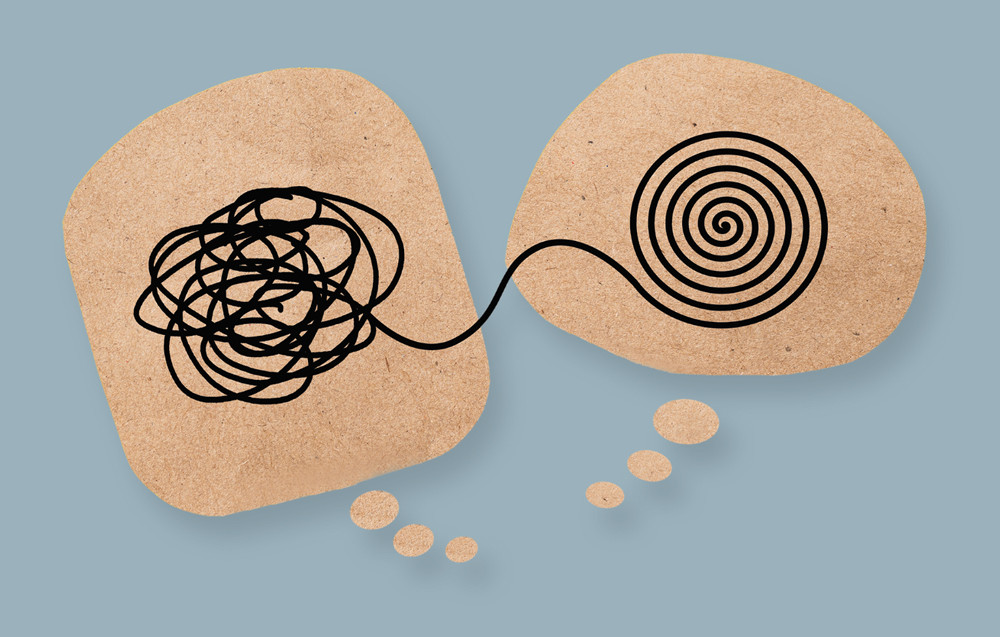
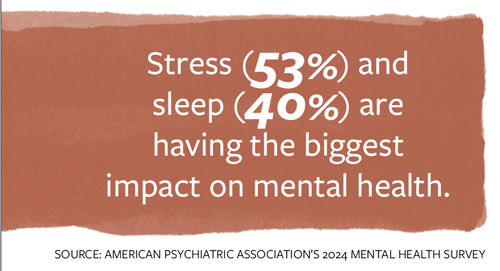
According to the American Psychiatric Association’s 2024 mental health survey, the last three years have seen anxiety among U.S. adults rise from 32% to 43%. With current events dominating the worries, stress (53%) and sleep (40%) are having the biggest impact on mental health.

Among anxiety’s most pervasive effects is the perception of lacking or losing control. The good news? Easy and accessible techniques for regaining and reestablishing a confident sense of control are readily at hand.
As Psychology Today stated in a May 2025 article, proactively “controlling the controllables” can help maintain a sense of balance and “make us feel like we can overcome moments of uncertainty and successfully tame the chaos.”
Many “controllables” match simple self-administered techniques from across the multidimensional world of health and wellness.
“Take EFT, or Emotional Freedom Techniques, for example,” said Kelly Gleeson Smith, senior vice president of sales at Caesars Entertainment National Meetings & Events, which has taken a forefront role in making wellness a meetings industry standard. “EFT starts with focusing on a specific stressor and then tapping, with a finger, acupressure points on the head, face and neck while verbalizing the problem at hand. I saw a pitcher warm up with EFT before a College World Series game—it recentralizes your focus and calms you down.”
Here are other techniques that attendees can “tap” into at any time to reduce stress, reset and gain control.
[Related: White Spaces, Unscheduled Gaps Give Attendees Breathing Room]
Seize the Day, Walk This Way
Want to win the day neurologically? According to behavioral scientist and happiness expert Arthur Brooks, professor at the Harvard Kennedy School and Harvard Business School, rising before dawn is scientifically proven to enhance focus, creativity and mood.
“If the sun is up, you are already behind the eight-ball,” said Brooks in an October 2025 broadcast on his six-step “super-charging” protocol that he says has “dramatically improved my life.”
Once awake, research finds that exercise and meditation help optimize the brain for focus and performance.
“Getting your body in motion helps to manage the negative mood that people commonly have in the morning,” Brooks said.
Meditation calms the mind while rewiring the brain’s ability to change and adapt. As Science News Today wrote in September 2025, “meditation is like a gym for attention, training the brain to focus and sustain concentration.”
Of all the forms of exercise that do not require a gym membership, walking reigns supreme for ease and impact. Stretching your legs provides numerous proven health benefits that only increase the faster, farther and more frequently you walk. These include preventing heart disease, stroke, diabetes and other serious illnesses; strengthening the bones, muscles and immune system; maintaining healthy weight; reducing stress and tension; and improving cognition, memory and sleep.
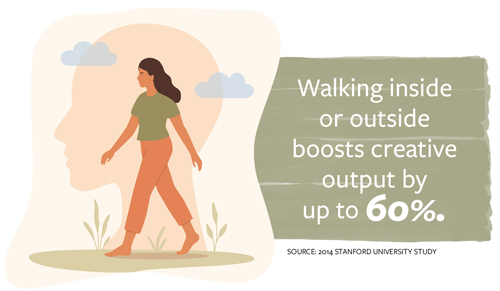
Published in 2014, a Stanford University study found that walking, inside or outside, also boosts creative output by up to 60%, with “creativity levels consistently and significantly higher for those walking compared to those sitting.” And, it is the act of walking, and not the environment, that counts, which means limitless possibilities for getting out of the chair.
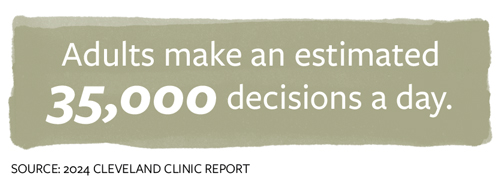
Mental gymnastics can also wreak havoc with focus and overall well-being. According to a 2024 report from the renowned Cleveland Clinic on cognitive overloading, adults make an estimated 35,000 decisions a day. Unmanaged, consequential decisions especially can overwhelm the brain, contributing to those negative emotions that many people experience when starting the day, leading to ill effects that can include tension-inducing physical strain, negative self-talk and burnout.
Effective counter measures that impart a sense of control include the proven productivity strategy of “eating the frog,” or starting the day by identifying and dealing with top priority tasks. This goes hand in hand with making lists and calendars, and deprioritizing tasks and decisions that are less critical.
[Related: Road Warriors: 4 Wellness Tips to Keep You Happy and Healthy While Traveling for Work]
Rediscover the Joy of Offline Living
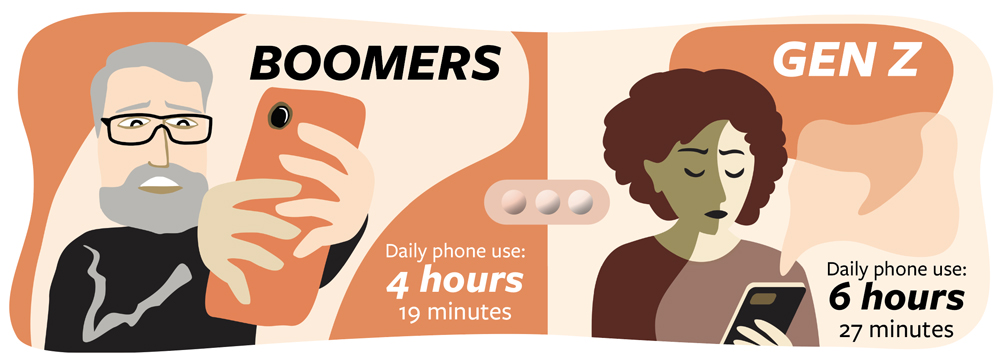
In a recent survey of cell phone habits, health data management firm Harmony Healthcare IT found that Americans spend a staggering five hours and 16 minutes per day on their phones. Boomers, at the “low” end, spend four hours and 19 minutes daily, bookended by Gen Z, which leads the disturbing trend of “bed-rotting” while “doom-scrolling” on their phones, at six hours and 27 minutes.
According to Forbes, “cell phones are quite literally designed to be addictive, and we’ve become conditioned to use them for far more than placing phone calls and sending text messages.”
Warning signs of cell phone addiction, according to a 2024 Harvard Business Review article, include:
- A deep and uncontrollable urge to check your phone even when you know there are no new updates or important messages
- Feeling lost without your phone, or anxious, stressed or irritable if you have to turn it off for periods of time
- Becoming “preoccupied with the thought of missing a call or text
- Negative emotions and moods, such as increased feelings of loneliness and depression
Borrowing from the language of chemical dependency and addiction, digital detox, or digital optimization, is the answer to reducing excessive intensive cell phone use. Intentional living expert Joshua Becker, author of the widely read Becoming Minimalist platform, has seven steps for breaking the cell phone habit.
The simplest are not charging your phone by your bed and putting your phone away when the workday is done, with the latter requiring that you set realistic boundaries on your availability. Also, dedicate at least one day a week, typically Saturday or Sunday, to leaving the phone alone, and set longer “reset” periods to adjust daily usage downward.
These same techniques apply to laptops and other screens, with the overarching goal of bringing greater mindfulness and control over screen time instead of “mindlessly unlocking your phone every three minutes.”
In its Annual Wellness Trends Report for 2025, the Global Wellness Institute (GWI) identified “analog wellness” as a self-care technique in an “online world awash with disinformation and divisive algorithms."
Calling 2025 “a pivotal year -for ‘logging off,’” GWI sees “people turning back to simpler times as individuals seek retro experiences involving vinyl records, old-school cameras, dumb phones, paper books and tactile arts and crafts.” Encouragingly, GWI calls this “a shift to rediscovering the joy of offline living.”
Not everything is controllable, and gaining control means staying the course. Whether walking, putting your phone down or better organizing your life, self-administered techniques for managing physical and emotional health and gaining control, while convenient and easily accessible, require the same consistent, disciplined, goal-driven mindset as any personal endeavor to succeed.
Two critical areas of health and wellness, nutrition and sleep, while controllable to a point, are subject to conditions that do not always fit the plan and require even more intentional, mindful effort to work. At the end of the day, though, self-empowerment itself is a form of taking control that can go far in boosting health, confidence, resilience, well-being and longevity.
“Since starting our wellness initiative in 2024, we did not anticipate the impact that it would have on planners and attendees,” said Gleeson Smith. “Our vision has really snowballed, including the ‘a-ha’ understanding that you do not have to break a sweat to bring wellness into the meeting space. And, that you can take what you learn in the meeting environment and incorporate it in your everyday life."