


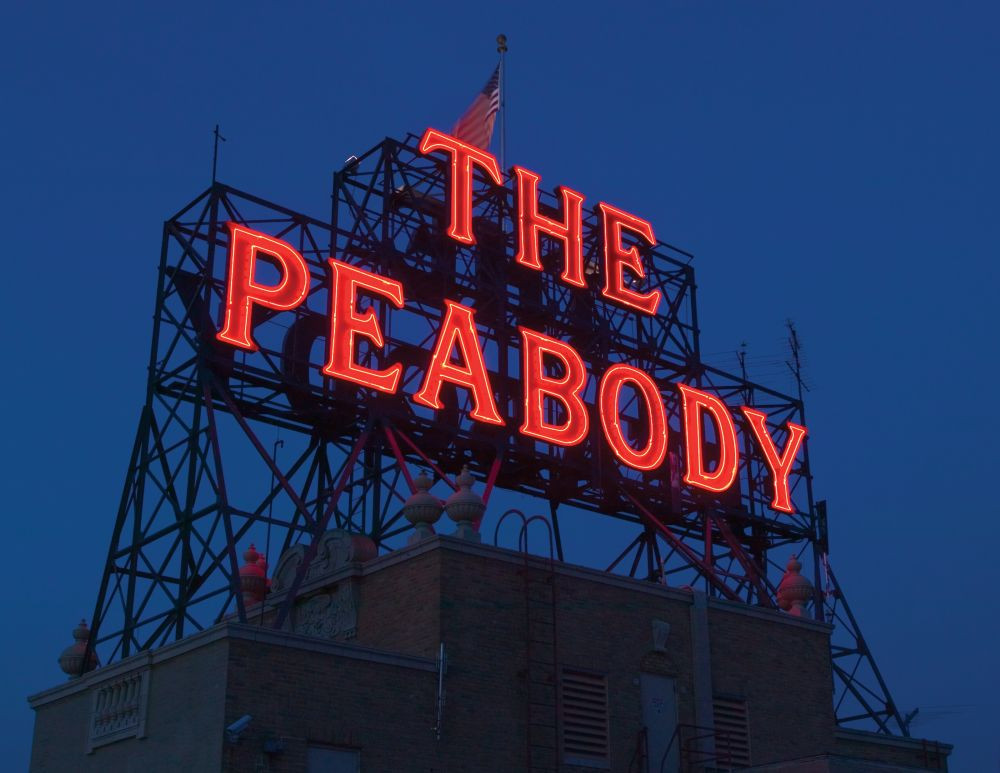
“More than a hotel, The Peabody Memphis is a place that speaks more to an experience, an adventure almost, that steps right in line with the uniqueness and authenticity that defines Memphis itself,” said Craig Smith, director of sales and marketing, to kick off our hour-long conversation over Jack Daniel’s cocktails at the hotel’s opulent Lobby Bar. “Like the city, the stories here have real teeth.”
The opening chapter began in 1869 with the construction of the original Peabody Memphis. Financed by and named for influential New England philanthropist George Peabody, the 75-room hotel, with its massive lobby and grand ballroom, became the social center of the South for meetings, banquets and special occasions.
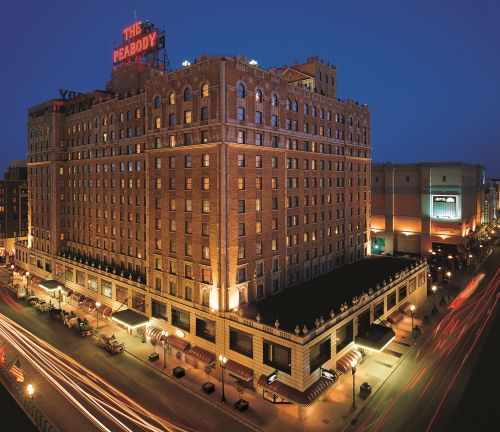
Rebuilt two blocks away in 1925, the larger, grander Peabody, with 625 rooms, cemented its status as the “South’s Grand Hotel.”
Like Memphis itself, the Italian Renaissance landmark is animated by the rich interweave of stories written by people who gathered here to share ideas around culture, civil rights and the city’s other driving forces.
The Peabody is entrenched in Memphis’s musical story. In the 1920s, early blues pioneer Furry Lewis, who opened for the Rolling Stones in the 1970s, was among the artists who recorded live blues sessions and played for record executives in the hotel’s guest rooms. In 2014, these rare, long-forgotten foundational songs, including “Rowdy Blues” and “Cottonfield Blues,” were released as the compilation Peabody Blues CD.
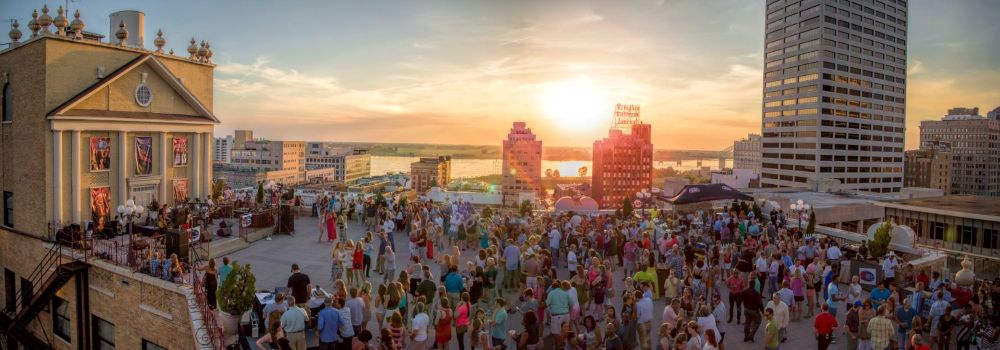
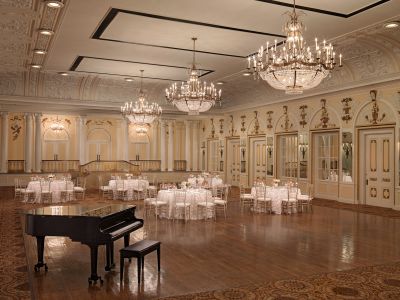
In 1939, enclosure of the east side of the hotel’s rooftop created the magnificent Skyway Ballroom. Paired with the adjoining outdoor area, the venues were the place to be for dining and dancing indoors and under the stars.
Attracting big band legends including Tommy Dorsey, Glenn Miller and the Andrews Sisters, the Skyway became one of only three national live broadcast sites for CBS Radio. Like Eloise at NYC’s Plaza Hotel, famously tanned Memphis-born actor George Hamilton practically grew up at The Peabody, where his father was a band leader.
The weekly CBS radio programs included “Saturday Afternoon Tea Dance.” From 1945 to 1950, the show was hosted by Alabama native Sam Phillips, who left to found his legendary Sun Records where he launched rock ‘n’ roll and in 1954, then unknown Elvis Presley.
Presley attended his high school senior prom at The Peabody’s peerless Continental Ballroom. Too shy to dance in his blue suede shoes, he sat out the evening. That all changed a year later with his debut recording, “That’s All Right, Mama,” at Sun Studio. Jumping to RCA Records soon after, Presley received his $4,500 signing bonus for his first national RCA contract in the hotel’s lobby in 1955. Look for the receipt, typed on Peabody letterhead, in the archive-rich Memorabilia Room on the mezzanine level.
Featuring a grand travertine marble fountain and painted coffered ceiling, the magnificent two-story, marble-columned lobby is also where Neil Diamond penned “Sweet Caroline” in 1969, which he subsequently recorded at Memphis’s American Sound Studio. Inspired by Presley and known as the “Jewish Elvis,” Diamond also wrote “Memphis Flyer” and “Memphis Streets.”
[Related: How Groups Can Feel the Inspiration and Emotion of Memphis, Tennessee]
When hard times hit Memphis in the 1970s, The Peabody went up for auction. Facing demolition, The Peabody was saved by another philanthropist, Jack Belz.
Swayed by his special connection to the hotel, including high school dates with his future wife Marilyn and their 1948 wedding at the Continental Ballroom, the local developer and entrepreneur purchased The Peabody in 1975. Investing $25 million in a painstaking six-year restoration, Belz reopened the hotel in 1981. The Peabody’s return to glory catalyzed the revival of downtown Memphis.
Along with nearby Graceland (1982) and the Beale Street Entertainment District (1983), which Congress had officially declared as “Home of the Blues” in 1977, The Peabody’s relaunch also sparked Memphis’s nonexistent tourism economy.
“The Peabody was the center of the renaissance,” Smith said, with the hotel for 20 years following posts at other illustrious flags including San Diego’s Hotel Del Coronado, the Greenbrier Resort in West Virginia and Wigwam Resort in Phoenix.
The star parade, which includes every sitting U.S. president since Harry Truman, Frank Sinatra, Sammy Davis, Jr. and Priscilla Presley, marched on in the new era. Best-selling author John Grisham, who attended his senior prom here in 1973, includes the hotel in several of his novels. Tom Cruise famously sprinted through the hotel’s under-construction 12th floor in the film version of The Firm (1993).
Scenes for The Client (1994) were filmed at the hotel’s event-capable fine-dining Chez Phillipe restaurant. Rare, if not underheard of in traditional French cuisine, the menu has a strict policy—no duck—in accordance with the hotel’s signature tradition, the twice-daily Peabody Duck March.
In 1933, general manager Frank Schutt and a friend returned from duck hunting juiced up on Jack Daniel’s. For a lark, they put their live duck decoys in the lobby fountain. Guests loved it. Replacing the three English call ducks with five North American Mallards, one drake and four hens, the hotel hatched a new calling. In 1940, bellman Edward Pembroke, a former animal trainer with Ringling Bros., taught his charges to march from their rooftop “Duck Palace” (a miniature version of The Peabody) to the fountain and back. Serving for 50 years as the hotel’s first Peabody Duckmaster, Pembroke, who once introduced his ducks to Johnny Carson on the Tonight Show, transformed the march into legend.
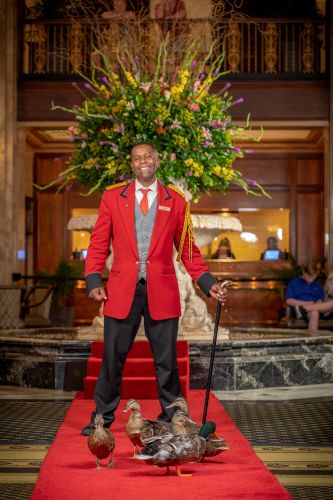
Current Duckmaster Kenon Walker, an actor and historian who previously led tours at Memphis’s National Civil Rights Museum, has upheld the beloved ritual since 2019. At 11 a.m. and again at 5 p.m., Walker, attired in a red coat with gold-braided epaulets, brandishes his duck-headed cane as he regales the packed lobby with the tale of his quacking ambassadors before leading them to and from the fountain on a red carpet to the accompaniment of John Philip Sousa’s “King Cotton March.”
Walker himself acts as a public face of the hotel, greeting guests, making media and community appearances and conducting daily history tours.
Like the ubiquitous duck motifs throughout the hotel, The Peabody, rescaled to 463 luxuriously appointed modern guest rooms, is hallmarked with an illustrious history of meetings, conventions and banquets.
Groups have 80,000 square feet of versatile space. The Continental Ballroom and historic meeting rooms are on the mezzanine level above the lobby, adjoined by the Grand Ballroom, which sits above the first-floor, 1,000-capacity Tennessee Exhibit Hall. Both have dedicated entrances from the expansive driveway and valet area. Plus, the third-floor Peabody Executive Conference Center, and Skyway Ballroom and outdoor Peabody Rooftop, which are sold together in case of inclement weather for 700-capacity events.
In a building where the walls not only talk but sing, the allure is less about square footage than stories and memories, enhanced by welcoming hospitality and employee pride.
As Belz says of his family-held treasure, “As long as there is a Memphis, there would be a Peabody.”