
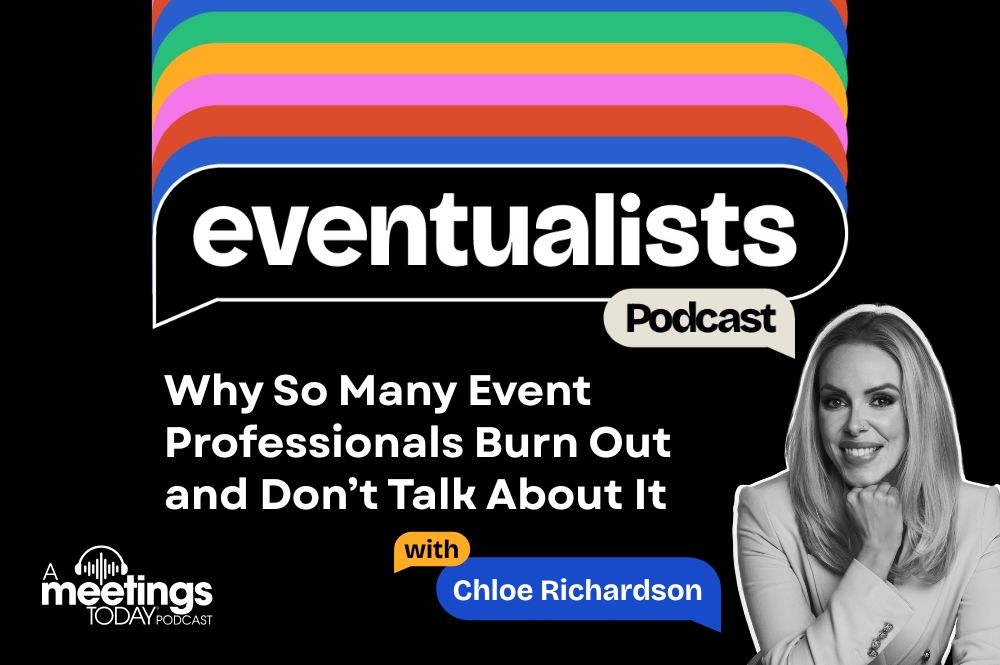
Why So Many Event Professionals Burn Out and Don’t Talk About It
Meeting planners and event professionals are expected to deliver flawless experiences, manage constant pressure and stay calm behind the scenes, no matter what happens. They work long and odd hours, spend many weekends and days onsite and are often expected to be available for clients 24/7. That need to be “always on” can take an emotional and physical toll on event professionals, but it’s rarely talked about openly and honestly, especially with those just entering the industry.
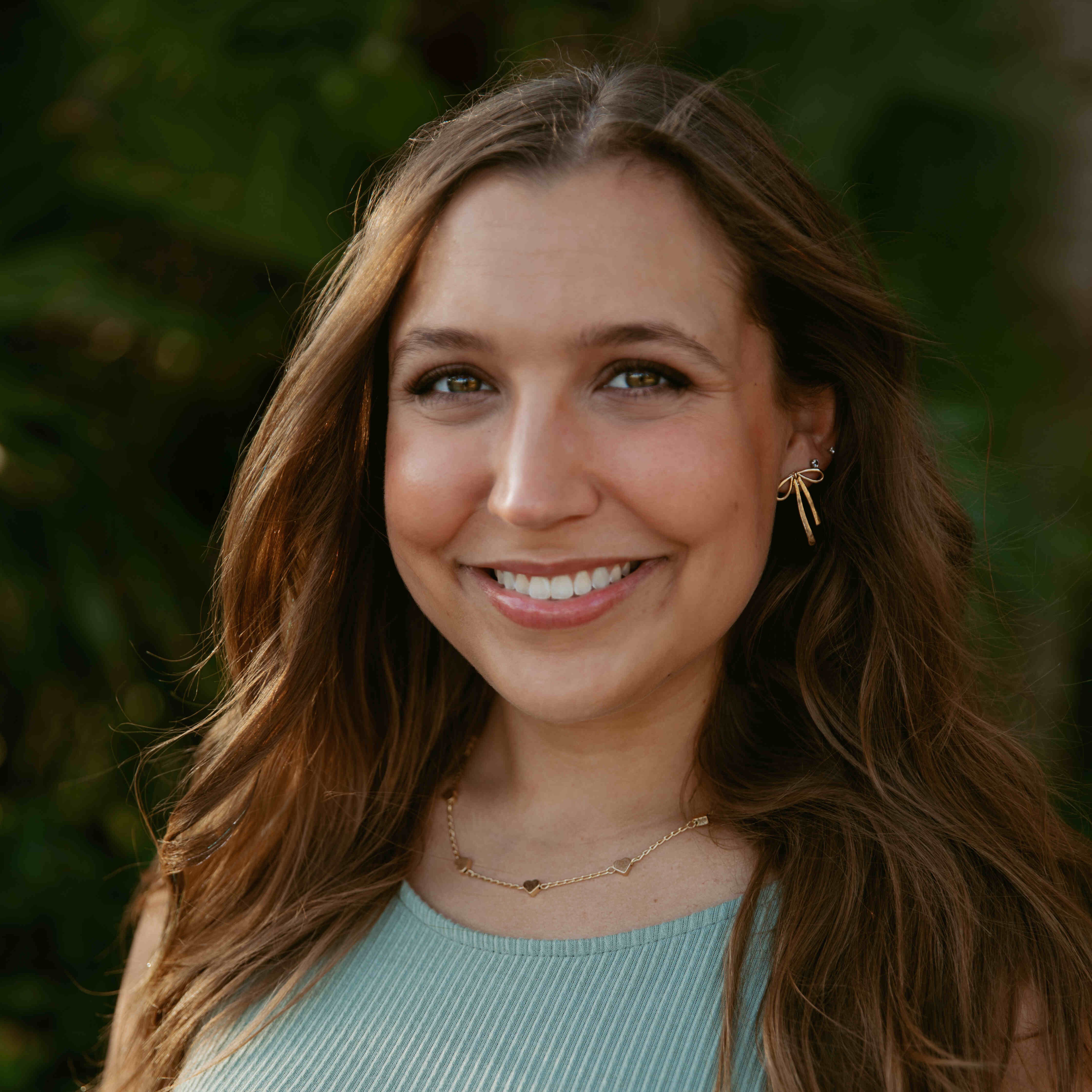
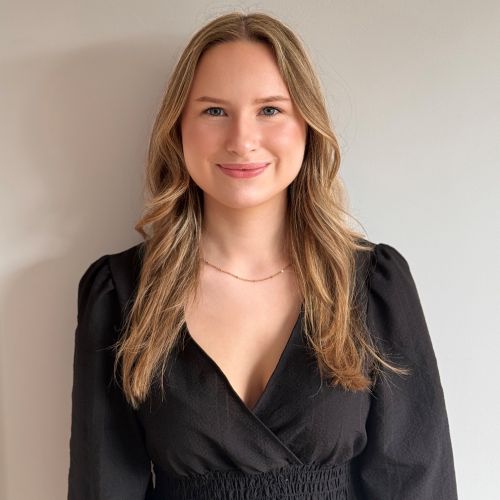
In this episode of Eventualists, co-hosts Hannah Elston and Taylor Smith are joined by ELX Head of Content Chloe Richardson to explore why burnout has become such a common experience in events, what causes it, how to identify it and why we shouldn’t be afraid or ashamed to talk about it. In the business events industry, there is a culture of overextension that can quietly shape early careers, but the Eventualists are here to pull back the curtain on the risk that comes with overworking yourself in a high-performance industry, especially when you’re just getting started.
Listen now:
Meet Our Guest:
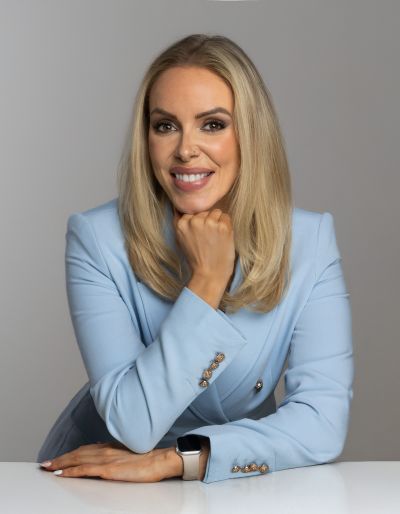
Chloe Richardson brings over 15 years of strategic insight to her role as head of content at Event Leaders Exchange (ELX). As both a guiding force behind ELX’s member-focused content strategy and the founder of Empowered by Chloe, she brings passion, purpose and precision to the world of event impact and communication.
She curates and develops ELX’s content programs and event agendas, ensuring every forum, summit and congress delivers meaningful value for senior corporate event leaders. As ELX’s resident emcee, Richardson also brings energy and clarity to the stage, facilitating discussions that spark insight and collaboration across the global community.
With more than a decade of experience in the business events industry, Richardson has built her career at the intersection of content, commercial growth and strategic partnerships. She is widely recognised for her ability to translate complex ideas into impactful conversations, and for her commitment to elevating the profile of event professionals on the world stage.
Passionate about the power of events as a driver for business and societal change, Richardson is also a regular speaker, moderator and industry commentator. She champions inclusivity, professional growth and the next generation of leaders in the industry.
[Related: What Does Gen Z Really Want?]
Transcript:
Editors note: The following transcription was exported from Microsoft Teams and proofed by our editors. Although it is very accurate, there inevitably will be some mistakes, so please consider that when reading. Thank you.
Taylor Smith
Welcome to Eventualists, real stories, eventual experiences, a new Meetings Today podcast for tomorrow's talent and today's leaders, co-hosted by me, Taylor Smith.
Hannah Elston
And me, Hannah Elston, the eventualists, sheds light on the unexpected realities of life as a business events industry professional. And today, we are excited to welcome our next guest to the podcast. But before we do, Taylor, hello. It's been a minute since we last filmed one of these. How are you? Have you got anything nice planned coming up?
Taylor Smith
I am excited for Meetings Today LIVE!, our first event of the year. It's just around the corner. I'll be leaving Sunday to head up to Milwaukee for our first event of the year, and that's very exciting because the Meetings Today team will be together in one room, and we all work remotely, so I don't get to see them often. It's just kickstarting a great season of events. I feel like after that first event of the year is when things just start rolling and they don't stop, right? I'm excited and that's a little bit of what's new, but Hannah, I know you've got a lot of new stuff going on. You were working from another country for a couple weeks. Tell us what little adventures you've had.
Hannah Elston
I actually thought it's funny, we were talking about this in our episode with Preston last time, but one of the things that Gen Z professionals obviously talk about a lot and really value is that ability to work remotely. I really put that in practice over the past couple of weeks, and I worked from Espana, so San Sebastián in Northern Spain, which was gorgeous. It meant that lots of my work days finished with sangria in the sun and way too much cheesecake. I am now officially on a diet. I've been eating nothing but low-calorie ramen since I've come home. But yeah, it was absolutely amazing, and the culture over there is just so different. Because of the time zones, I was able to work a little bit later and have dinner later. Oh, it was absolutely lovely. Thank you, Taylor.
Taylor Smith
Of course, it sounds like the life that I want to be living. I'm jealous. One day I’ll get out there.
Hannah Elston
I'm planning to go back for sure. It was beautiful. So definitely, if you don't utilize your remote working, I highly suggest you take the time and you travel somewhere and enjoy working from another country with another culture somewhere. With that, Taylor, shall we get into bringing on our guest today?
Taylor Smith
Yes, let's go.
[Listen to more podcasts from Meetings Today: Dare To Interrupt]
Hannah Elston
Let's get in with the latest new eventualist and a dear friend and colleague of mine, Chloe Richardson, who brings 17 years of strategic insight to her role as head of content at Event Leaders Exchange. As both a guiding force behind ELX's member-focused content strategy and the founder of Empowered by Chloe, she brings passion, purpose and precision to the world of event impact and communication. Chloe and I actually met almost three years ago to the day, I've realized, because we met at Gatwick Airport on our way to IMEX Frankfurt back in 2023, which is already coming around the corner. And honestly, we hit it off then, and we have been friends ever since. I'm incredibly excited for this episode with Chloe today.
Taylor Smith
We're going to dive into why burnout has become such a common experience in events, what causes it, how do I identify it and why we shouldn't be afraid or ashamed to talk about it. Chloe, I know you said you've got no secrets. You're here to talk about those real conversations, so let's dive in. Thanks for joining us.
Chloe Richardson
Thank you so much for having me. I'm feeling an element of pressure after that incredible introduction. So, thank you both. But yeah, I'm ready. Let's get it all on the table. No holding back. I'm not messing around today. And when it comes to burnout, actually, when Hannah first reached out to talk about this topic, I was a little bit like, oh, I don't feel like this is something I know that much about. Then we had a bit of a chat and I was like, wait a minute, this is kind of everything that I live and breathe. So yeah, really thrilled to be here talking about this with you guys.
Hannah Elston
So excited. I knew as soon as this topic came up, I thought there was no one better to bring on than you, to be honest, because there is no one else I go to for advice around this kind of stuff. I know you've got loads of wisdom to share today.
As we start every podcast, we're going to ask you a little question. You're already very well established in the industry, but how have you identified with being an eventualist?
Chloe Richardson
Yeah, an eventualist. I think what common mistake people often make is that they think once you're past the first 10, 15 years of your career, you've got no learning to do, right? The adventure's over, the journey's over, you've got all that expertise and thought leadership and there's nowhere to go beyond that, and I don't think that's the case at all. In fact, I really live my life embodying the idea that I get my happiness and fulfilment from achievement and from challenge. In order to constantly be challenged, you constantly need to be driving towards new heights and having new experiences.
I think that's exactly what an eventualist really is. It's about knowing you don't know everything and being open to these experiences and open to growth and open to learning and knowing that no matter what stage of your career you're at, there's still ample opportunity to develop personally and professionally.
Taylor Smith
Hannah, I think we might have to rewrite our definition after that. That was so perfect.
Chloe Richardson
As I was speaking, I was like, this sounds scripted, but I swear I haven't read the questions. I totally forgot what we were even really going to go into today.
What I'm going to just draw out as an example here, I did a mentorship scheme a couple of years ago as a mentee. I had so many people come up to me saying, you're a mentee, shouldn't you be a mentor? I almost felt a bit silly for wanting to know more and develop. I think when you're slightly younger and more junior in the industry, there is a pressure of feeling like you don't know enough, there's also that reverse pressure when you get a bit more established in your career, where people expect you to know everything, or at least to think you know everything, and that's just not the reality. Learning, growth, it is for everyone. And I like to try and amplify that message as much as I can.
Taylor Smith
That couldn't have been more perfect, I don't think. We can end the podcast there. She's nailed it.
Hannah Elston
I think it's so relevant as well because I remember growing up, my grandparents always used to say to me, ‘you're never too old to learn.’ I used to teach them how to sort things out on their phone and stuff like that, his email password and whatnot. But it's true in your career as well. There's always gonna be something new that you can learn. and anyone that thinks they know everything definitely does not.
Taylor Smith
Chloe, as an older or more established industry veteran, that pressure that we have to know everything, even if it's subconscious and we don't even know we're doing it, that might be when burnout starts to creep in a little bit because we're not asking for help and we need to know everything and do it all.
Chloe Richardson
Yeah, and I think as well, we put this pressure on ourselves to do everything, but also to lead by example. When you do have new people coming into the industry, my fear for those that have been here a long time, and that's why we're starting to see burnout, especially in senior leaders, they're not taking the time to look at their own experiences and their own struggles because they're too busy focusing on their graduates or those that are new to the business. That is a huge problem that I think we're facing. Not only are we working so hard, not only do we have fewer resources than ever, budgets are shrinking as we know, we're having to do more with significantly less, expectations are rising, whether that be from our stakeholders or our attendees, and the pressure lands on us—that's where the book stops.
I think it's human nature to not want to appear weak and vulnerable, and I get it because psychologically it does make sense. The problem is you will get to a point where you just can't take it in your brain anymore, that is when internally you start to crumble and then externally you start to crumble.
I've been talking about it quite a lot over the last year or so, particularly on LinkedIn. I'm a huge advocate of just saying, you know what, I'm not okay. I had a tricky end to the year, which Hannah knows a lot about, and people were coming up to me saying, how are you doing? We were at events, we were running events, and I was just like, you know what, I'm not going to pretend anymore that everything's easy. I'm just going to be honest. Not only did that do me a world of good because it releases that pressure from inside of me, it also meant that other people felt comfortable with being open about their struggles and their vulnerabilities.
I think as leaders in this industry, that's something that really needs to be represented. That is okay to not be okay. And since I've posted a bit about that on LinkedIn, I've had messages from people saying, ‘thank you so much for saying this. As a result, I've told my boss I need a little bit of time off, or I started to add diary blocks that mean that I get some free time to do exercise or spend time with my family.’ Just knowing that me saying I'm not okay made a few other people be able to say it too, I think is a really powerful thing. So yeah, burnout is something I think is worse in our industry than many others. I mean, what is it? It's the third most stressful industry, they say, after military and caregiving. And I'm not surprised because it's not just the fact that we're working hard. Hours are irregular. We travel a lot. We have a lot of pressure. We're constantly surrounded by people, so we can't let that mask crack. You're constantly having to play this role whilst also being strategic, practical and intelligent. And that's a lot to come into one human body.
Taylor Smith
It's exhausting is what that is.
Chloe Richardson
Yeah. I mean, even talking about is exhausting, isn't it?
Hannah Elston
Yeah, I was just saying that. It literally makes me exhausted hearing it all spelled out like that. But it's so true. And it ties into something else that I really wanted to ask you, because as someone who's on stage so much of the time as an MC or a speaker or a moderator, you have to show up with energy and with a smile on your face, no matter what's going on behind the scenes. How do you do that while also still protecting your own well-being? I know you mentioned there that you tell people maybe to the side that, you know what, I'm not going to lie about this. I'm actually not okay. But just on the day-to-day, how do you balance that? How do you protect yourself?
Chloe Richardson
I'm really big on prioritization. I have my own kind of internal priorities, and I say to myself, first of all, as you know, Hannah, when I'm at work and on the job, I don't drink. I get early nights. Sleep is a huge thing for me. I try and get 10 hours a night, which everyone finds hilarious, but actually I'm doing really well at the moment. So, I'm celebrating that. But it's not only that.
I kind of have three checkboxes and I ask myself, is the thing I'm about to do going to either fulfill me, mentally, is it fun or is it good for my health? And if it doesn't tick any of those boxes, then I'm not doing it. So if, for example, we go to an event and there's an offsite party in the evening, and I realize actually all that's going to make me do is feel like crap tomorrow, it's going to make me more stressed, it's not going to do good for my body, and I'm not going to be able to wake up early and do a quick run before I go on stage, which is one thing I like to do, but then I'm not doing it. I kind of have these rules that I set for myself and a lot of people ask me, ‘how do you not go to these things? And how do you remove yourself from these environments?’ It's really easy because when I'm torn, I have to ask myself, is this night out going to make me better at my job? Or is it going to make me happier long-term? Or is getting that sleep more important? And when you ask yourself that question, the answer comes pretty quickly.
Sometimes, the night out might be the answer, because we do need to have fun, and that's why that part's important, but it's being able to say, if it doesn't tick any of those boxes, I'm not doing it, and that I find really helps what I'm seeing because you cannot have a minute where your brain tunes out when you're on stage. I mean, you both do this. You know what it's like when you're interviewing people, you have to be listening to their answers. You have to be formulating responses of your own. You have to tighten themes and pull out trends. You have to be engaged. So, this is why it is so important for us to be able to take our own peace seriously as well.
[Read more: The Z: Planning for the Industry’s Next Generation]
Taylor Smith
How do you allow yourself to take your own peace, I guess for me, one of the biggest challenges I face is I feel obligated, I feel like I have to go. I feel like I put a lot of that pressure on me as a young professional where if I'm not in the room, I'm missing out. But I'm also someone, Chloe, who needs her sleep. If I don't get my sleep, I wake up and I am not nice the next day. I know I'm not going to be happy on that trade show floor if I go to rendezvous, but I have to go to rendezvous. So, what is your advice, I guess, for putting yourself first when you feel like you're putting your profession second, I guess.
Chloe Richardson
Well, it's asking yourself that question again. Is this really going to benefit my career? And the answer could be yes. And that's also fine. Hey, I go to rendezvous every year. It's also maybe picking and choosing because I'll go to rendezvous and I know I'm not going to do anything else that week in the evenings. It's about cherry-picking. In the same way people cherry-pick which of our events they attend, we have to do the same. We cannot go to every single event and we wouldn't expect our attendees to go to every single event in their sector throughout the year. Let's treat ourselves with the same respect we would treat our attendees and just say, let's pick one or two of these this week that we want to go to. That's because we'll enjoy them, but also professionals will gain from them. And the others, I'm afraid, unfortunately, I can't prioritize them this time around, but maybe let's see if we can go to them in 2027.
So, this is another rule that I have is I don't say no, but I believe in the power of no. And the reason why I believe in the power of no is because I say ‘no, but.’ If somebody says, can you come to this? Or can you get this done for me before next week? When I know I'm at my mental capacity, I will say ‘no, but, I can do it if you can extend that deadline by three weeks or no, but I know somebody else who could come tonight and take my place who'd be a really valuable addition.’
I think if you kind of use the ‘no but’ rule as well as having that internal checklist, you're covering yourself for all bases and you're also not putting someone else out because I think that's the worry, especially when you're new in the industry is you don't want to upset anyone else. You don't want to disappoint them. It's that constant crushing feeling of, oh God, if I don't go to this event, someone's going to be unhappy with me. But if you're presenting them with other options, then they are going to be happy. If you just explain, unfortunately, I can't go tonight just because I know tomorrow won't feel great, but I've got a great colleague who's going to come and bring all the fun and be incredibly entertaining, and they will do it on my behalf this time. No one's going to begrudge you of that. We're all human.
Hannah Elston
Chloe, I have to ask you something because you know I am a FOMO sufferer. I have the worst FOMO. I think because we work in this industry as well, I'm obviously in event marketing, creating FOMO is what I aspire to do all the time. And everyone else in our industry also does a very good job of it. So I always have FOMO. Can you talk to me about JOMO?
Chloe Richardson
I'm glad you brought this up. First of all, for those of you that are listening, watching, and don't know Hannah that well, you will know she is the worst at FOMO. Taylor and I don't know each other very well, so Taylor might be the same, but Hannah makes me laugh. She will do a 12-hour flight, she will land on eight hours time difference, she'll be exhausted, she'll have worked all day and she has to go out. Nothing you say to her will keep her in her hotel, even though she knows it's not the right thing for her, and she's going to feel it in the morning, she still does it, and it makes me laugh. Like Hannah said, I believe in JOMO, which is the joy of missing out. And unfortunately, I don't think it's something that you can be taught. It just kind of comes with experience.
But I get such pleasure in not going to so many whole events, and it sounds really bad. I love socializing. I'm a huge extrovert. It's one of my favorite things to do. However, there's also other things that I love, and so when I'm able to tell myself, because I haven't gone that night out, that means I can go to bed at 9 o'clock and not only will I have an excellent night's sleep, but it means I can get up and I can run for an hour in the morning and I know tomorrow's going to be a great day. That's all I need for my mindset to see that as such a joyful decision that I've made and I never regret it.
There's never been one party I've not gone to that I felt bad about afterwards. And I love that everyone else is having fun, but I know that there are other things that are important to me that I can't do if I go on that night out. It's kind of a balancing act and I guess it's sacrificing one thing for the benefit of the other. I think the secret maybe is just shifting that mindset for it not to be, ‘oh God, I'm missing out on all the fun,’ but to be, as a result of this, ‘I'm going to be able to do my face mask tonight. I'm going to be able to listen to my podcast. I'll get to read my book.’ All the other things that also bring me joy and I'm able to do because I'm not going. So yay for me and I'm going to stay in bed for 12 hours.
Taylor Smith
That is what joy sounds like to me, staying in bed for 12 hours with a face mask on.
Chloe, I'm like you, when I land, I'm like, get me to my hotel room. I need to decompress. I need to shower. I can't go straight from the plane out. Like, Hannah, maybe you need to sprinkle a little bit of your magic FOMO pixie dust on me.
Hannah Elston
I don't know if it's necessarily a good thing. I mean, Chloe is not wrong, I will literally land in Vegas, go straight to the bar after I drop off my bags. I believe last time we were there, I stayed up until like midnight on the first night.
Chloe Richardson
She'll be texting me going, I'm so exhausted. I can't see. I've gone blind. I don't wanna be here. Why am I out? I'm like, go to bed. But Hannah's got a crippling fear of missing out. I do get it to an extent, when it is all glitzy and new, but I would just say there's loads of other things, Hannah, that I know you love and get joy from.
Next time I challenge you, give it a go. Tell yourself I'm not going to go. Tell everyone else early, because that's another thing. I'm really honest about this. I don't pretend I'm not one of the people who goes, oh, I'll see how I feel. I'm like, no, I'm not. Have a great time. I won't be there. But that also helps too, because you disappoint people more the later you leave the rejection. And so, if you just get out the door early, I'm not going to come. I love what you're doing. I'm not going to be there. It just takes that pressure off everybody. And then you know what? You might change your mind and then everyone's even more happy because you've underpromised and overdelivered. So, there's a win-win.
Hannah Elston
I know exactly what you're like. I'm just like, nope, not going to do it. And it actually makes us so happy on the times when you do come as well. It's like an extra special surprise. I'm like, ‘oh, yes, Chloe's out tonight.’ Whereas with me, it's like, I feel like I've created an expectation for myself to always be one of the last people standing. So, you have, I guess, set your boundary so well from the beginning, which is fantastic.
Chloe Richardson
It does come with a negative because I now have the reputation amongst some people and I have been called boring on numerous occasions, particularly by men in the industry. ‘Oh, you're so boring.’ I'm like, ‘yeah, yeah, cool,’ because tomorrow you're going to spend four hours on your laptop answering emails, and I'm going to spend it on the stage interviewing our senior leaders for an ELX event.
So yes, you might find it boring, but I don't care because we're different people. We have different priorities and that's up to you. I don't judge you for going out every night and I don't, I celebrate whatever people want to do, but also I think is part of the burnout problem. Is that because it's still seen as taboo. It's still seen as I wear the badge of honor 'cause I don't sleep.
We are still in the process of shifting that mentality and that perspective. I'm hoping that the more of us that are honest and say we need sleep, that's okay, then more people will feel comfortable being able to say no to these things that aren't actually part of their job.
Taylor Smith
That ties into another question we had, which was along the lines of, you know, burnout is, it's not, you know, exclusive to the meetings industry, but it's so common. It's something that we all kind of feel and just quietly accept as normal and some are like, ‘oh, you're not going out tonight. You are boring. You're supposed to be burned out. You're supposed to be working yourself ragged all those hours.’ Why? Why do you think that is? Why do we do that in this industry?
Chloe Richardson
I believe, and I briefly mentioned it earlier, we're not good at bragging about how good we are, whether that be as individuals or teams or even an events function, and we see that across various different elements of the industry.
One thing I talk a lot about on stage is event measurement, is how we need to be better at justifying event spend and at measuring and demonstrating the impact and value that the events function brings, because we're constantly competing with digital marketing channels or socials, and they have analytics at the click of a finger, right? We often say things like, ‘oh, there was a buzz, or, oh, I saw loads of people today and the energy in the room was great,’ but for a CFO or somebody managing budgets, that isn't going to stand.
Particularly post-COVID, when a lot of events were pulled and a lot of budgets were redistributed, we find ourselves in the position where if we don't find a way to prove the impact our events function makes on business outcomes very specifically, then we're going to start losing budget and we're going to start seeing that being pumped in elsewhere. We're going to start losing colleagues. We're going to start losing events that we used to do on a regular basis, and that's a huge industry problem, right? Speaking the language of the business to demonstrate impact is something that so many people are struggling with at the moment. We're seeing people getting laid off. We're seeing, again, budgets being sliced, we're seeing events being dropped. But not only that, it's kind of filtered down. So, when I was talking to a few people recently about how they incentivize their teams, their event team specifically, it's never really done on actual KPIs that link back to the event production. It's done on things like how many leads did we get onsite at this trade show? Or how many sales converted 18 months down the pipeline? What does that have to do with the event coordinator, whether the sales team actually converted those leads or not? Nothing. But we've got so complacent in proving our impact in a way that the business understands.
As individuals, we don't collect the data on ourselves either. We work so many hours a day, we're countlessly on flights, we have no social life with our friends and family because we're always working and yet we aren't bragging about it enough. I think that's the main problem. We've almost created this environment ourselves by not being good at bragging about what we do. If we don't prove our value, we don't get the budget or the headcount, and suddenly one person in the events function is doing the job of three or four or five or even 10 people because we haven't proven enough that what we do is important and we need the extra resources. So, that's another part.
We are seeing it on LinkedIn every day. Event professionals, senior ones all the way down to kind of junior entry level, losing their roles, being made redundant, event teams being cut in half or even worse in some cases, and it's because the business doesn't believe in us. That natural byproduct is, we're even more burnt out because we're having to pick up the work that now there's no one else to do, right.
Taylor Smith
And it's thankless because no one's thinking you need to do it. Right.
Chloe Richardson
They don't know what we're doing because we're not explaining it well enough, and I really wanna stress, it's not 'cause we're not good at our jobs. I think I would say to anyone in any industry, if you want someone that's gonna work hard and be intelligent, hire an events professional. I don't care whether it's in technology, pharmaceutical, manufacturing, retail, I believe that event industry folk are the hardest working in the world, genuinely.
We're not good at talking about how good we are. That's something that I think if we can master, we'll start to see a drop in burnout because not only will we have more resources to take on the work, but we'll also have people that appreciate us, pay us more. We'll have more work-life balance, we hope, who knows? Sorry, that was a really long answer to your question, Taylor.
Taylor Smith
It was the perfect answer. It's what we're looking for.
Hannah Elston
Absolutely. And I think, Chloe, what you touched really well on though is, it's our responsibility as individuals to combat burnout, why it's happening to us, how we can hold ourselves accountable in a way that goes, ‘actually, we need to do better, not just for us, but for our teams and for the industry as a whole, right?’
We've spoken quite a bit about the individual's responsibility when it comes to burnout. I would love to know, from an industry leadership perspective, what responsibility do organizations have in preventing burnout and not just reacting to that?
Chloe Richardson
I think there's a couple of things. I'm just thinking off the cuff here, but the first thing that came to mind when you just said that was, I feel organizations have a huge responsibility to play in leading by example, particularly when it comes to time off, working hours. It is a responsibility of the organization to really hammer home as soon as an employee joins. When you are on holiday, you put your out of office on. It's important that the organization does not contact that person when they're out of office, unless it's an absolute emergency. It's important that businesses have really clear handover processes for when someone does go away. Hannah, you're really great at that. You put everything down on a piece of paper and you send it to all of us and you say, if you need anything whilst I'm away, here's your Bible. Consult this, but you weren't like that when you first started because you just didn't want to disappoint anyone. You were constantly replying to emails in the middle of the night when you're off on the beach and whatever it is.
I remember, I took you aside, you remember right at the beginning, I was like, ‘Hannah, you're on holiday.’ The problem is, leadership often doesn't teach us the right example. When a leader replies to messages whilst they're on holiday, they are telling their employees and their team, I expect you to do the same. That is the culture change. Leaders need to take time off. Organizations need to put processes in place to make sure that people are covered when they're not working.
Once it starts coming from the top, it should filter down and then it will just become habit. Working hours again, make it clear what hours you work and around that, turn off your notifications. I don't get team notifications after 6:00 PM and I certainly do not get them in the weekend. If I'm travelling, yes, I might do a little bit of work because I'm a contractor, right? I have to work flexibly, but I would never message anyone else expecting them to respond to me out of office.
I've started to see people have put in their signatures. I don't know if you guys have seen this where they say, ‘I'm replying to you because these are my working hours, but I don't expect you to reply to me until your working hours,’ and just little things like that in company signatures can make all the difference because these are tiny tweaks and we're giving people paid time off. We want them to enjoy their time off. We want them to love working for us. We need to honor those boundaries and set them ourselves as leaders so that our teams, particularly our younger, newer members who are grappling with how to work in a kind of full-time corporate environment, it's important that we show them rather than tell them how we want them to act.
Hannah Elston
Chloe, you've just reminded me, that was such a wake-up call when we had that conversation because I took my laptop with me to my girls trip in Greece. I would wake up early in the morning and be on my laptop from the villa, and honestly, at the time, I was like, ‘wow, look at me. I'm working so hard’ and all of this.
I'm looking back like, no one wants to be that guy. All my girlfriends just wanted to go out for breakfast, and there I am on my laptop checking in on my registration numbers. That's not a flex. They were probably feeling bad for me at the time. And so now, like you said, the biggest thing that I could do to protect myself was I made a document called Hannah's Brain is I called it. And I just said, if it's not in here, I do not know the answer. So, you have to think about who else you could ask because I don't know it. So that was my way of protecting my space to be like, I don't need to bring my laptop because absolutely anything you could want from me is here for you.
I think one of the things that I've had to do since stepping into a leadership role myself is create that process for members of my team when they're away. They don't need that whole brain, but there is a process that we have to make sure that whatever needs to be covered is covered and if we have a question, we can find it somewhere online. I think that has been such a great evolution.
Chloe Richardson
I think it has too. I think huge organizations need to be doing the same thing and they don't. The problem with the example you gave about you working on your girls holiday, not only probably were your friends a little bit annoyed that you weren't joining in, not only were you probably a bit annoyed because you weren't having as much fun as they were, but then I don't imagine probably, and I am one of your colleagues, but your colleagues, they weren't like, ‘oh, thank you so much.’ They probably just took it for granted. You end up resenting your work as well because you're like, ‘I've done all this, give me extra recognition,’ but actually, you need to be able to set your own boundaries and say, ‘I'm not going to do this this week.’
Another example I can think of when we did the briefing for this call, obviously you guys did it on teams and I put my camera on because I was hiking in a mountain in Cape Town and you were like, that's so funny. I was just like, I want work life balance, but also I want to sometimes blend the two. If I can have a call whilst I'm up a mountain, why not? I wouldn't host an event from like Camps Bay, but if it's a briefing call, why not? I think it's things like this as well. The more leaders have calls where they're dialing in on a walk or even at the airport just to maximize time, do it. I think then your team is gonna look and say, ‘oh, I can do that too then.’ Not only will it create a much more positive working culture, it will reduce burnout, but also it will increase loyalty because people will feel like their own time is respected.
That's another phenomenon we see, particularly with millennials, but it's drifting into Gen Z. People are leaving jobs so quickly now. I mean, I think the average for Gen Z is two and a half years, right? I think my record is like three and a half years. I've been at ELX for four and a half, and that's the longest time I've ever spent anywhere. But, it's because when you feel like your company doesn't value you anymore, generally because they're giving you too much work, you're generally overworked, but also they don't respect your boundaries, that's when you leave. So, what a great way to reduce burnout is to lead by example.
Hannah Elston
I love to add as well, so quickly, Taylor, I just have to add that with that trip as well, you were saying, I bet you weren't getting loads of thanks for doing that on your holiday from anyone on the team as you're doing it, that is because, I guess, no one's asked you to do that. And actually, I got the opposite. I didn't get thanks. I got in trouble because it was, what are you doing on your laptop in the morning in Greece on a Friday? You said you were taking the time off, take the time off.
Chloe Richardson
It was me that said that to you. I'm really sorry.
Hannah Elston
No, no, no.
Chloe Richardson
I think I actually swore at you in capital letters and was like, Hannah, get the F off your laptop, go and enjoy your holiday.
Taylor Smith
We need more people like that, Chloe.
Chloe Richardson
But hopefully we'll all start to do it, right? Because as a generation, you guys are a little bit younger than me, but we're in similar generations. If we all talk about this a lot and say, this is what we expect, and sooner or later, when we are the leadership workforce, this is how it'll be for everyone and we'll laugh. It'll be the new normal.
Taylor Smith
We need that new normal. For people like Hannah and Chloe, listening to these conversations and the dynamic between the two of you, I'm so happy, Hannah, that you have, Chloe, to like drill this into you, to be like, sign off, go use your PTO, because, you know, like Chloe said, if we don't set those examples and tell young professionals that it's okay to set these boundaries, they might not even know where to start. And for someone just entering the events industry, Chloe, what boundaries do you wish you had learned to set earlier that anyone listening today, maybe if they don't have that mentor who, like Hannah had you, they could take away from this podcast and go set that boundary and make it even a small change tomorrow.
Chloe Richardson
Oh gosh, okay, this is hard. I've always been quite good at saying no to stuff. But no, what I probably would say, and one thing that I've got much better at now, which I do is habit, is I did allude to it earlier, but calendar blocking. I think a really good way to set boundaries is to be really open and honest about the fact that it can be really easy, especially when you're working from home, to sit in front of a desk and just sit here for nine hours and just bash out work and be super productive and amazing, but then you haven't given your mental health or your own time any consideration at all. What I do now, which I wish I'd have done 10 years ago, is every afternoon or every morning, I block out time for exercise and nothing will impede that time.
It's important for me that I get that, but also it's important that others see that that's what I'm doing so they feel comfortable to do it too. I wish someone had told me that when I was younger because I felt so embarrassed about needing to get outside for half an hour. I'm not a big kind of lunch person, but what I do like to do is exercise. So instead, I generally work through lunch, but I'll do my exercise in the morning and I wish I knew that there was an element of flexibility and as long as the work was done, you don't need to kill yourself in order to do it and you should never sacrifice what's important for your own mental health for a business because at the end of the day, we're all replaceable, whereas we are our own humans and we can't replace ourselves, right?
I think that's important and that flexibility and knowing that you can be open and honest. Because back when I started to work was like, I got my first full-time job in events in 2012 and no way would anyone have dared to admit that they were going for a walk for half an hour, which is crazy to me now. So that's probably the one thing that I would love to tell old me. You can do that and you can still be successful and you don't have to pretend that you're living and breathing your life, your work always, because that's not realistic. It actually makes you a better professional when you do have that balance. It also makes life much richer and fulfilling. So yeah, but hopefully somebody listening will pick that up and start doing their own time calendar blocks. But also I do it even in my social time too. I don't wanna spend all of my weekend just being out and about with friends and family. Love them all, but I still need to have my own time then as well. I've really made that a habit, which is quite a good one.
Hannah Elston
Chloe, my question for you after hearing that is I think there are some newer professionals that want to feel confident enough to do that and block in their calendar, I'm going to Pilates this morning or I'm doing this or I'm doing that. But there's this fear of being labelled as not committed or being difficult or, you know, prioritizing yourself and not your work. Some people, unfortunately, don't have really supportive leadership, maybe the way that we do. How can young professionals advocate for themselves without having that fear of being labelled based on that?
Chloe Richardson
This answer is probably twofold. First and foremost, I would suggest, and this is something that I hate suggesting to people because it feels like you're counting hours and it almost feels like a score sheet, but I do think it's important to note down what it is that you do and what you achieve during the day. Not only does that make you feel confident in, ‘oh my God, I've done so much today, obviously I'm going to go for that half an hour run,’ but it also means if you do get questioned, you've got something to present back. Again, it's about having the data and insights to prove the impact and the value. There's that side of it. I used to have an Excel spreadsheet that had a new tab for every month that I would list everything I'd done every day. I used to look back and I was like, ‘wow, I've done so much. Why am I beating myself up about the fact I wanted to go and do a spin class? This is insane.’ There's that side.
But then the other side is, even if your leadership isn't perhaps that understanding, I would try and find an internal advocate that is. I would seek out somebody within the business that maybe you've seen be really clear with their own personal boundaries, or you've seen them talk about it or even you've seen them out on a run during a call. Have a chat with them and ask them would they feel comfortable to advocate for you or how they did it. Having that internal support can be really valuable, and you'll probably find that it's not as difficult as you think it is. But speaking to someone else and getting that validation can be really important.
Taylor Smith
Sometimes all we need is that reminder that we're not alone.
Hannah Elston
Oh, that was so beautifully put. Thank you, Chloe. I mean, you have helped me personally through my career journey with this in particular so much. So, I'm really honored to be able to have you on here and share more of that wisdom with our listeners. So, thank you so much. This has been so lovely. I've been really looking forward to bringing you on.
Chloe Richardson
Thank you. It's been a pleasure. Taylor, it's been so lovely to get to speak to you more. Hannah talks about you all the time. It's a pleasure.
I know I say it, but if there is anyone listening who wants to reach out about this and has any other questions or just even wants to maybe vent about something, I am a good person to do that with. I'm honest, I'm independent and I will tell you really what I think if that's what you're after. I am hoping we are going in the right direction, and I think progression is being made, but again, it needs to come from the top. It needs to be embedded throughout a business, and individuals also need to feel comfortable to be able to assert their own boundaries. So thank you so much for having me. It's been so lovely to chat. Hopefully I'll see you both soon.
Hannah Elston
Yes, see you soon. Snaps for that. Thank you, Chloe. Taylor, I think it's time for us to wrap this up.
Taylor Smith
Yeah, you want to take us out of here, Hannah?
Hannah Elston
I'll take us out. Thank you all for listening to this episode of eventualists and diving into real-world questions and experiences shared by us and our listeners. For more eventualists content, follow Meetings Today's social media platforms and @eventualists.podcast on Instagram.
Taylor Smith
Whether it's a bold question, an anonymous confession or a candid conversation with a courageous podcast guest like Chloe, the eventualists are here to unpack it openly, honestly, and without judgment to help teach emerging leaders lessons they will find useful in their careers eventually. We're your co-hosts Taylor Smith and Hannah Elston.
Hannah Elston
This episode was produced by Meetings Today's Maddie Willis. If you liked this conversation, add to it, e-mail Maddie at eventualists.podcast@gmail.com.
Taylor Smith
New episodes of eventualists will air every third Thursday of the month. Thanks for tuning in. We look forward to sharing more experiences and conversations with you eventually.