


When meeting in a coastal destination, attendees invariably want to grab some beach time, so planning a social event on the beach is an obvious consideration.
But far from being that proverbial laid-back, leisurely “day at the beach,” planning an event on the sand presents numerous challenges, from permitting and F&B logistics to making sure the gathering is accessible to all, such as for people who use wheelchairs or have other mobility challenges.
[Related: 4 U.S. Beach Destinations for Meetings and Events That Deliver]
Other considerations for staging a successful beach meeting include:
- Having a backup plan if the weather does not cooperate
- Transportation to get people to the beach if their host property is not beachfront
- Shade and hydration stations
- Protection from the sun for attendees and staff, such as hats, sunglasses and sunscreen
- Comfortable seating options
- Easy access to bathrooms
- Entertainment options
- Post-event cleanup

We spoke with meeting professionals who have recently held beach events to get their take on the essentials to consider and potential pitfalls to avoid.

Kathy Sadler, project manager to Dean Elaine M. Wallace at Dr. Kiran C. Patel College of Osteopathic Medicine, Nova Southeastern University, has collaborated on a wide range of events in beach locations, including in Florida, Delaware, South Carolina, Aruba, Jamaica and Mexico.
“Beach events require a unique level of adaptability; everything from weather patterns and surface stability to guest comfort,” Sadler said. “Beach events are never a solo event, as the coordination must include considerations such as permitting and local regulations, particularly coastal regulations; all weather contingencies; flooring; tenting; equipment stabilization and protection; guest experience, including accessibility for all guests, footwear and hydration; and vendor coordination in non-traditional environments and more-remote locations.”
Access the Digital Edition of Meetings Today Florida
Beach as Photo Op
If a meeting agenda is just too packed for a full-on beach soiree, it would almost seem cruel to not incorporate an easily accessible beach for at least the bare minimum: a group shot on the sand, if only for a little liberating toe wiggling and FOMO for those who will see the shot but didn’t attend.

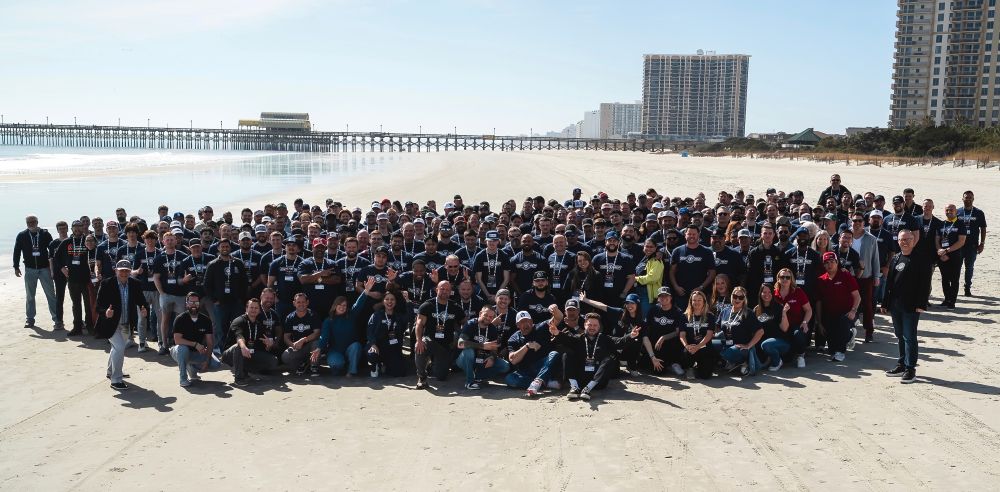
Christina Thockey, finance and events manager for Top Rep Sales Training, produced a mid-February event at Embassy Suites by Hilton Myrtle Beach Oceanfront Resort that was crunched for time but still prioritized getting attendees corralled for the obligatory group shot on the sand.
“We always take a group photo after lunch the second day, and because there are so many [attendees], it’s like corralling cattle,” she said. “I was making nearly 300—almost 95% men—walk all the way out to the beach and I thought, these people are going to complain about sand in their shoes, or some of them have suits on. But everybody loved it! They were turning around to their own teams and taking their own group photos, and everybody was like, ‘Wow, thank you so much for getting me out in the sunshine in the middle of the day,’ because you’re in a ballroom all day.
“We joked that the hotel staff was going to hate us for dragging in all that sand in our shoes on the way back!” Thockey said.
5 Tips for Planning an Event on a Beach

We tapped Kathy Sadler, project manager to Dean Elaine M. Wallace at Dr. Kiran C. Patel College of Osteopathic Medicine, Nova Southeastern University, for five essential tips for planners executing a beach event.
[Related: Take a Coast-to-Coast Tour of Florida's Main Meetings Offerings]
Following are her responses:
- Respect the environment and regulations because ultimately, the beach is a protected and public space unless the event is held on a privately owned island. Preservation is extremely important. Build the event around protecting and not just utilizing the space. Working closely with municipalities early is helpful. Some bigger resorts have those permits in place.
- Planning events needs to be based on probability, not possibility, as it relates to weather. Beach events can be produced flawlessly if you work with the elements and not against them in a reactionary manner. Wind, sand, sun, coastal tides, time of day and, of course, hurricane season can be the biggest factors. As with wind, everything must be properly secured: decor, signage, tents; flooring, seating stability, AV items and guest comfort are critical factors. With sun exposure, everything from guest comfort to food safety must be considered.
- Load-in logistics for all staging, DJ and food and beverage are critical logistics. The operational plan needs to be shared with all teams in the group resume to ensure all parts and pieces come together in a well-timed order to be set well before the start time of any guest arrival.
- Guest comfort for beach events needs to be curated with careful intention. There needs to be shaded areas; hydration stations set up; comfortable, all-inclusive seating; and ensuring ahead of time with the group if there are any special accessible accommodations required among guests. Restrooms and accessibility should be well thought through to make certain the most comfortable experience may be produced for the event.
- A strong contingency plan is non-negotiable and a key piece of the puzzle. Plan B must be communicated with teams prior to the day of the event as the weather can shift very quickly. Being able to pivot quickly without sacrificing any part of the event or experience is critical. In fact, great meeting and event planners will perfect Plan B while designing Plan A.
Beach Event Tips From a Florida DMC Expert

Karen Best, market director for DMC Hello! Florida, is well versed at throwing beach soirees.
Here are some of her topline tips for shoreside festivities.
Permits & Regulations
- Most beaches require special event permits, often from the city, county, or state (and sometimes multiple agencies)
- Alcohol rules vary widely - many beaches prohibit alcohol entirely or require special licensing and permits well in advance
- Certain beaches require environmental or coastal permits, especially if structures, tents, or staging are involved (to protect dunes, sea turtles, and vegetation)
Expect restrictions around:
- Event size and footprint
- Amplified sound
- Tents, staging, décor installations
- Open flames and cooking equipment
Timing & Curfews
- Many beaches have strict event end times, often earlier than typical outdoor venues
Seasonal wildlife considerations (sea turtle nesting, bird migration) can significantly impact:
- Lighting (often red or amber only)
- Noise levels
- Set‑up and breakdown windows
Also, sunset timing matters, not just for guest experience, but for lighting compliance and safety
Load‑In, Setup & Access
Load‑in takes longer than traditional venues due to:
- Limited or distant parking
- Long pushes across sand
- Restricted vehicle access
Many suppliers require:
- Sand‑friendly wheels or beach carts
- Temporary matting or pathways to protect dunes and improve access
Build in extra buffer time for:
- Setup and breakdown
- Vendor arrival sequencing (you can’t always stage trucks nearby)
Power, Infrastructure & Utilities
Beaches often have no built‑in power or water, so consider the following:
- Generators must be permitted and sound‑mitigated
- Fueling and placement may be regulated
Limited or no access to:
- Restrooms (portable units are often required)
- Hand‑washing stations
- Trash and recycling services
Load calculations need to account for heat, wind, and sand exposure.
Weather & Environmental Factors
Wind is a constant variable:
- Impacts linens, florals, tents, signage, and audio
Heat and sun exposure require:
- Shade structures
- Hydration stations
- Cooling towels or fans
Always have a Plan B for:
- Rain
- Lightning (especially important in Florida)
- High wind conditions
Guest Comfort & Accessibility
Sand creates challenges for:
- Guests with mobility concerns
- Heels and formal attire
Consider:
- Clearly marked pathways
- Advising appropriate footwear in advance
- Expect public interaction unless the beach is private. Permits do not usually make beaches exclusive
Sound, Lighting & Production
- Amplified sound almost always requires additional permits and volume limits
- Lighting restrictions are common, especially during nesting seasons
- Outdoor acoustics on the beach can be unpredictable, so audio reinforcement needs extra planning
Cleanup & Leave‑No‑Trace Policies
Many permitting agencies require:
- Full post‑event beach cleanup
- Removal of all decor, sand stakes, and cabling
- No confetti, florals, or loose décor that could impact the environment
Trash removal plans are often reviewed as part of permitting.
How to Create an Inclusive Environment for Beach Events

Everyone loves an event on the soft sands of a beach, but this environment can pose significant challenges for those with mobility issues, such as wheelchair users or older attendees.
To make sure everyone in the meeting feels welcome, Visit Panama City Beach (VPCB) has made accessibility a central focus through its “Fun. For. All.” initiative, which was designed to ensure visitors of all abilities can fully experience the destination.
With 27 miles of shoreline and more than 100 public beach access points, Panama City Beach has invested in infrastructure such accessible boardwalks, ADA-compliant ramps and mobility mats that extend across the sand to the water’s edge.
Beyond physical access, the destination focuses on highlighting accessible attractions, accommodations, dining and transportation, and has also earned recognition via the Wheel the World “Destination Verified” program, which evaluates and strengthens accessibility across local partners, ensuring a consistent and reliable experience.
[Related: 4 Ways to Accommodate Attendees With Disabilities at Events]
The “Fun. For. All.” initiative emphasizes thoughtful planning and continuous improvement, creating an environment where visitors don’t have to search for accessible options—they’re already built into the experience.
We checked in with Jayna Leach, senior vice president and CMO of Visit Panama City Beach, to see how the destination goes above and beyond to serve everyone who travels to the northwest Florida destination for a meeting.
Tyler Davidson: How does VPCB support accessibility on the ground, and how is this integrated into meetings or events?
Jayna Leach: Panama City Beach has made accessibility a core part of the on-the-ground experience through features like Mobi-Mats, accessible boardwalks, ADA beach access points and beach wheelchairs. These amenities allow individuals using wheelchairs or mobility aids to move with ease from parking areas across the sand and even down to the water. With more than 100 beach access points and newly developed, fully accessible boardwalks, accessibility is built into the physical infrastructure of the destination.
As a beach destination, many events are held directly on the sand, from weddings and family reunions to beach bonfires and company retreats. In terms of meeting space, many of our venues are ADA compliant, offering accessible entrances, restrooms and layouts that support a wide range of needs. This allows planners to seamlessly pair beachfront experiences with indoor meetings or events, creating a cohesive and inclusive experience from start to finish.
What are the most important accessibility considerations planners should think about early on for beach events?
Early planning should focus on attendees’ physical barriers and needs while in the destination. On a beach, that means prioritizing accessible entry points, mobility equipment availability and proximity of parking, restrooms and drop-off areas. Sand can be a barrier; ensuring a continuous path from arrival to the event space is essential.
Where is accessibility most often overlooked in beach event planning, and how does VPCB help address those gaps?
Visit VPCB helps address these gaps by centralizing accessibility resources and information in one place through its “Fun. For. All.” microsite. This hub provides planners with an overview of available infrastructure, services and accessible experiences, making it easier to identify needs early and plan accordingly. By putting everything in one accessible location, planners can proactively build more inclusive events without having to piece together information from multiple sources.
How do you work with planners to ensure accessibility is balanced with other logistical considerations like transportation, site setup and guest comfort?
We work closely with planners to identify locations that naturally support both accessibility and overall event flow, whether that’s proximity to host properties, transportation routes or essential amenities. By aligning on these elements early, accessibility becomes part of the overall planning strategy rather than a separate consideration.
From what you’ve seen, what details make the biggest difference in creating a beach event experience that is both seamless and inclusive for all attendees?
Simple, intentional details, like clear pathways across the sand and thoughtful layout, can make a big impact. A planner with inclusivity in mind ultimately creates a better experience for every attendee.