

When who you’ve been is no longer who you are becoming, your identity has been disrupted. But what causes this unpredictable change or transition in one’s life is often unknown. How can one moment, experience or period in time change the trajectory of your confidence, and who you are?
The concept, known as “identity disruption,” can often be the byproduct of career grief, which is triggered by change and uncertainty in one’s professional life: shifting jobs and the threat of downsizing. Much of our identity lies in our career goals, professional achievements and external validation from clients and colleagues—hearing high remarks from our superiors or receiving a pat on the back for a job well done.
[Related: 4 Stress-Busting Tips for Meeting and Event Planners]
This is especially applicable to meeting planners. Their careers are often measured by high-pressure benchmarks such as attendee counts, satisfaction scores and ROI.
In an industry with a lot of mobility, identity disruption can feel as if you’re the main character in the center of a snow globe that won’t stop shaking.
Until the snow settles, you have two choices: sit around, wait and do nothing; or ask yourself, “How can I deal with my life circumstances when I can’t see what’s ahead of me?”
Put a Name to What You’re Experiencing
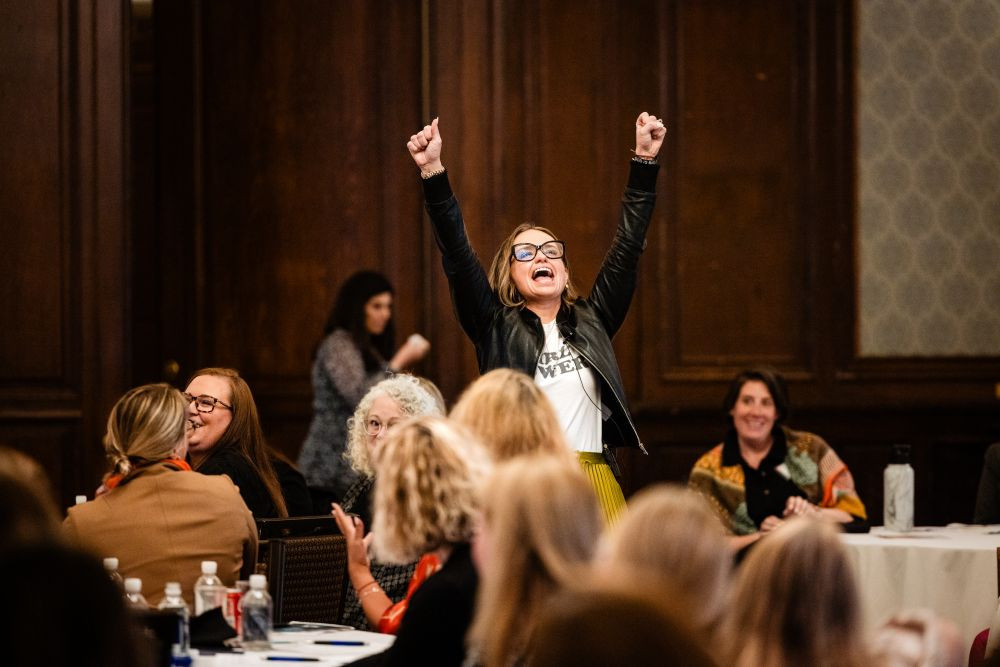
Megan Miller, founder and CEO of UNLEASHED, started speaking publicly on a quiet resentment within herself she could not name—a concept she calls “identity disruption.”
Before founding UNLEASHED, Miller spent 15 years in the hospitality industry, overseeing a portfolio of properties across the country. She had multiple leadership roles, including national director of sales.

“I thought I could outrun [the feeling] by working harder, by getting more accolades, by getting more achievements, by booking more business,” she said. “The hospitality industry is based on people’s experiences. So I thought if I got more clients, if I got more people to like me, if I got validation, that it would outrun the resentment.”
This feeling stirred inside Miller for about five of her 15 years in the hospitality industry.
“Going through that season alone, in so many of my identity disruption and expansion moments, made me want to create the language,” she said, “so that another individual doesn’t navigate that season in isolation.”
[Related: A Breath of Fresh Air at Meetings]
To navigate her season of identity disruption, Miller began with awareness. She didn’t have to outrun anything; her feelings paved the way for opportunity. It was a season of growth. So, she set out to form a community around identity disruption and expansion, and out of that came UNLEASHED.
“When we have tools, when we have community, what we can do is so powerful,” she continued. “There is a kindness in this industry to truly help each other. I have never seen an industry like it. What makes it so great is the humans in it.”
Job Loss Is Just a Story
KiKi L’Italien, host of the Things Go Sideways podcast and founder of personal-consulting firm Amplified Growth, described her recent job loss as a “dramatic situation.”
L’Italien attended the 2025 ASAE Annual Meeting and Exposition last August, where she was recognized with a lifetime achievement award—the ASAE Academy of Leaders Award—on account of her 16 high-performance years working with associations.
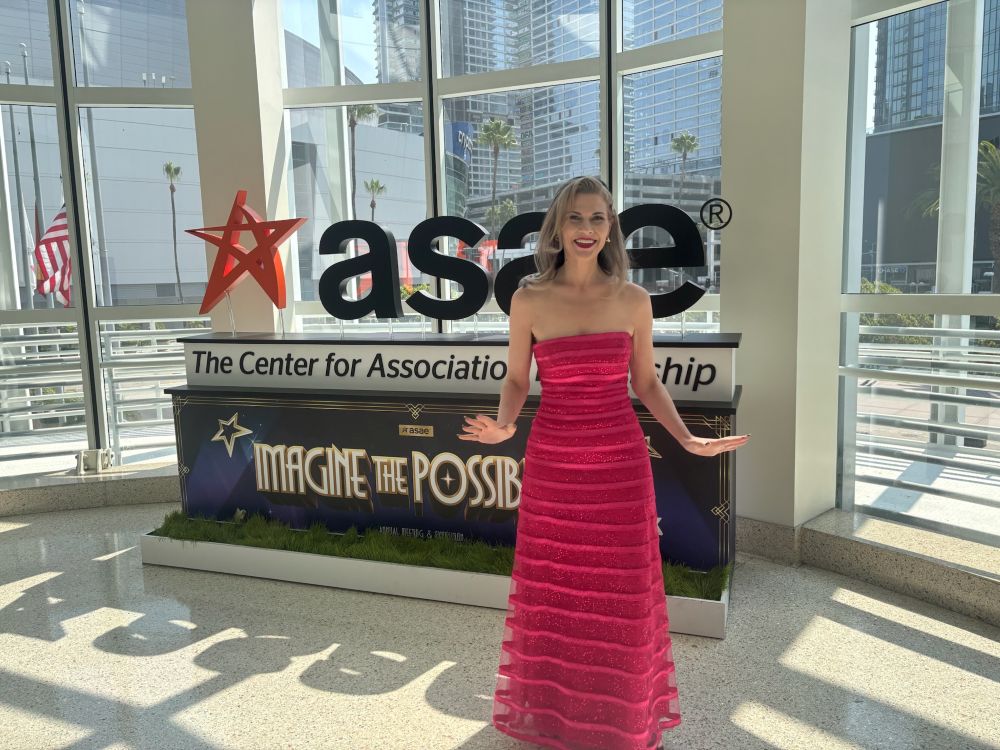
Just one month prior, L’Italien was let go from the role she committed herself to for the last 10-plus years—the role ASAE was honoring her for.
“And when that changes, if it’s unexpected or even if you know it’s coming, I think that it’s hard to reckon with,” she said. “Who am I now? And who do I choose to be? And that’s kind of scary for people.
“I had less than a month to figure out, ‘What am I going to say to these people, and who am I when I show up on that stage?’” she continued. “‘How can I say something that’s going to mean anything when I don’t even know what I’m going to do next?’”
Despite the identity disruption L’Italien was facing in August, she took the stage at ASAE’s Annual with elegance and poise. Excited to put on her fancy pink dress, L’Italien addressed the audience with honesty and integrity.
[Related: WITT Releases New Wellness Credential for Meeting Planners]
“I got up and I made my speech about how I’m receiving this award at a time when I don’t know what my next step is,” L’Italien said.
The day of L’Italien’s layoff, July 3, became her independence day. She felt like her platform was no longer her own, but she still owned the stage like it was.
“We start out with a path that feels solid beneath our feet, but then life does what life does, right? It gives us a plot twist,” L’Italien said in her award acceptance speech. “The job loss. The identity shake-up. The version of the future that we thought was true and real and solid vanishes overnight.”
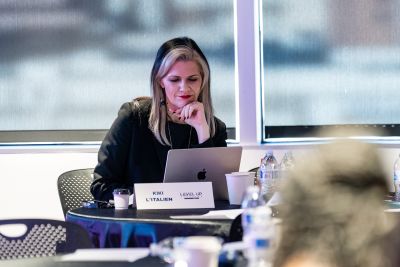
But for L’Italien, her job loss became another story for her to tell so that others can relate and avoid experiencing identity disruption in isolation.
“I think there are enough stories in this world that can go all kinds of ways,” she said. “I’ve been collecting them for the podcast.”
Things Go Sideways, L’Italien’s podcast and newsletter, keeps readers and listeners going when they don’t have clear answers. In these conversations, L’Italien and her guests create structure and “emotional scaffolding,” focusing on real stories of resilience and transformation from leaders navigating disruption.
Together with her guests, L’Italien is learning from the experiences of others, and helping them pick up the pieces in their own stories.
One guest in particular “was talking about something that he did until he could get into the right mind space,” she said. “It took him 13 days; he went around his living room, and he just repeated this mantra to himself: ‘I have a world-class mind.’”
In a world that is quickly changing, we have to rely on ourselves and our world-class minds.
Facts vs. Feelings
When it comes to job loss, L’Italien says the facts of the situation and what they mean can be different from how we feel about them; we have to separate one from the other.
L’Italien’s feelings around the job market being weak right now also happens to be rooted in facts. The U.S. Bureau of Labor Statistics found that the U.S. economy lost 92,000 jobs in February while the unemployment rate rose to 4.4%.
[Related: Accessible Action Steps for Taking Control of Physical and Mental Well-being]
“We no longer feel safe, we no longer feel that the world as we know it exists around us, and in times of uncertainty, we have to make decisions differently, because it is a matter of survival,” she said.
L’Italien’s experience with job loss has even poured over into parenthood.
“And so one of the things I’ve told my daughter is, ‘No matter what you study in school, I want you to learn how to negotiate contracts and how you can create business,’” she said.
After being thrust out of her job, L’Italien acknowledges this job market is paving the way for identity crisis, but in her time of uncertainty she prides herself on this: “It goes back to understanding yourself at your core. If you know who you are, what you believe in and what your strengths are, I really do believe you can figure out whatever that next step is going to be.”
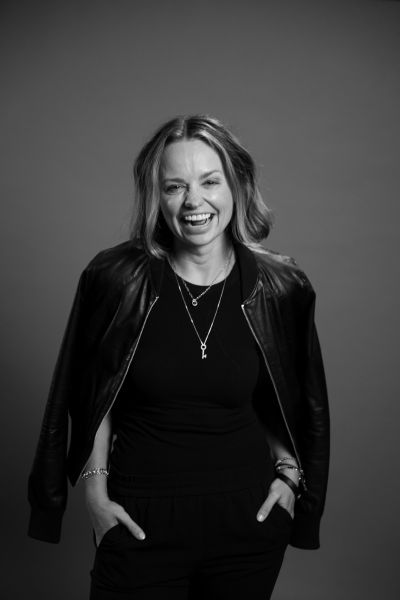
Authoring the Next Chapter: A Note From Meg
By Megan Miller, founder & CEO, UNLEASHED
Planners build timelines, anticipate problems before they happen and create solutions for everyone else. But how can they look inside to create moments for themselves? In their everyday endeavors, here’s how they can seek moments for growth.
Expansion doesn’t happen at the end of a perfectly built spreadsheet. It happens in the doorway moments, the micro-decisions we make every day.
The moment before you speak.
The moment before you say nothing.
The moment before you take action or don’t.
In these micro-moments, we have a choice: repeat the version of ourselves that feels safe or step into the version of ourselves that is asking to expand.
Here are three tools to help you walk through that doorway with intention.
Tool 1: Upgrade the Question, Upgrade the Decision
Better questions interrupt old patterns and create new ones. The next time you’re facing a decision, ask yourself: “Am I making this decision to gain approval or because it aligns with who I’m becoming?” The answer will change the decision that follows.
Tool 2: Interrupt the Speed of Your Thinking
We’ve been taught speed equals efficiency. So, we Google the answer. We ChatGPT it. Expansion doesn’t come from speed; it comes from space. Spanx founder Sara Blakely went from selling fax machines to building a billion-dollar brand by using her car time in silence. What could surface if you created space to hear the voice inside you?
Tool 3: The One Question That Makes Action More Likely
How do you start your mornings? Is it by reacting to everyone else’s requests of your time or by setting your own intention? Before emails, expectations and deadlines, ask yourself: “What would I regret not doing today?” Then do it. Expansion doesn’t happen when you feel ready. It begins when we make and keep a promise to ourselves. Write one of these prompts on a sticky note in your office, your car or your bathroom mirror. Because the person who ultimately chooses how you walk through the doorway of expansion is you.
Love, Meg