




By Vincent Alonzo
On April 22, more than 10,000 Earth Day events unfolded across the globe—river cleanups in Bali, regenerative tourism pledges in Canada, LEED-certified renovations in Tampa, and a wave of “conscious luxury” messaging from hotel brands worldwide.
The meetings and events industry showed up as well. On paper, at least.
Sustainability in events has never had a messaging problem; it’s an operations problem. And as of today, the industry must get back to where things matters the most: execution.
For an industry that generates an estimated 114,000 metric tons of waste annually, with roughly 60% of show-booth materials ending up in landfills, the stakes are hard to ignore. The figures, cited from the joint industry report Finding the Future, Together (2022) by Society of Independent Show Organizers (SISO), Center for Exhibition Industry Research (CEIR), and UFI: The Global Association of the Exhibition Industry, point to a significant systemic challenge.
Earth Day 2026 provided a snapshot of where the industry thinks it’s going — and how leaders are defining that trajectory.
At Mandapa, a Ritz-Carlton Reserve in Bali, a river cleanup along the Ayung River was framed as part of a broader ethos. “We believe that true luxury is inseparable from responsibility,” said Masanori Hosoya, general manager of the property.
In Delhi, the message centered on consistency over campaigns. “Our commitment to conscious luxury is not limited to a single day; it is embedded in our everyday operations,” said Hardip Marwah, general manager of Andaz Delhi by Hyatt.
And in Canada, “Regenerative tourism is about leaving a place better than you found it,” said Marsha Walden, president and CEO of Destination Canada.
In fact, shifting from sustainability to regeneration may be the most important signal coming out of this year’s Earth Day. But it raises a difficult question for the meetings industry: How do you translate that ambition into the mechanics of a meeting facility or tradeshow floor?
Rebuilding Right Under Our Feet
For decades, carpeting has been one of the industry’s most visible, and wasteful, fixtures: installed for a few days only to be discarded afterward. Now, that model is shifting as manufacturers rethink materials in a circular way.
Freeman’s GreenStep Aisle Carpet, introduced in early 2026, is designed as a closed-loop system, allowing used material to be broken down and remanufactured into new carpet products. “This helps event organizers take meaningful steps toward sustainability,” said Anytra Lowe, EVP, client solutions at Freeman Company. “It’s a practical solution that moves the industry forward.”
[Related: Next Level Event Sustainability, and 4 Hotels Doing It Right]
That sense of urgency is echoed across the category. Brumark, working with Fern and ExhibitorLive, has introduced a fully recyclable carpet initiative to tackle the tens of millions of pounds of flooring waste generated annually. “Responsible action is not only the right thing to do, but vital to the long-term health of our industry—the impact of this program is immediate and practical,” said James Zacharias, president of Brumark.
Other players are expanding the circular model beyond carpeting. Graphic Image Flooring has developed take-back programs that convert used vinyl and mats into industrial materials such as insulation and automotive components. And modular design firm beMatrix is pushing the concept further still with its Re-Connect Floor system, which replaces disposability entirely with reusable, rotatable tiles designed to circulate across multiple events.
Bringing the Heat
At the Pennsylvania Convention Center, the sustainability story comes with a twist: less waste, more heat—and smarter systems behind both.
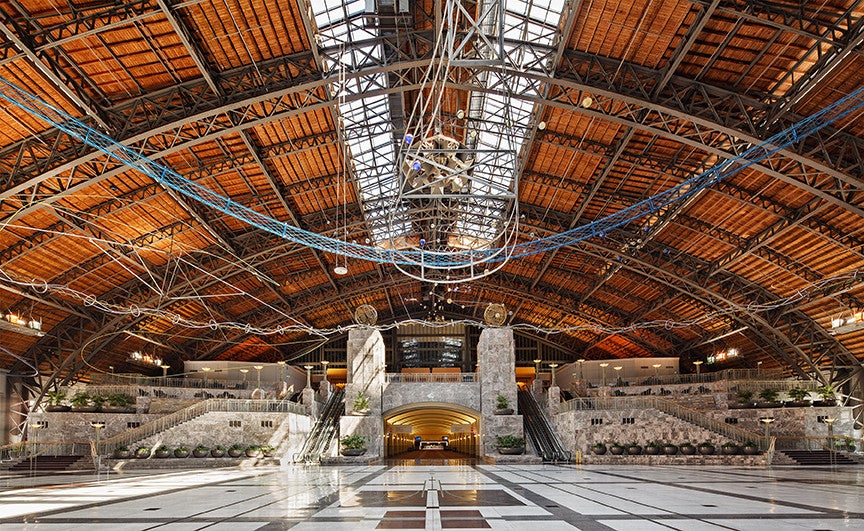
According to PCC’s 2025 operations report, electricity use dropped 15% and water usage was reduced by 17%. Natural gas? Up 22%. And while that might sound like a step back, note that the increase is tied to two new absorption chillers coming online at its power plant, using heat instead of energy-hungry compressors to cool the building more efficiently at scale.
Then there’s waste—the metric that matters most on the show floor. In 2025, the PCC reached a 45% diversion rate, while total waste volume fell 25% and landfill tonnage dropped 14%.
Translation: It’s not just about recycling more. It’s about throwing less away in the first place.
That shift isn’t happening in a vacuum. Exhibitors and organizers are rethinking materials, builds, and booth lifecycles—proving that sustainability isn’t a post-show cleanup effort anymore. It’s a design decision made long before the doors open.
[Related: New and Renovated Properties That Prioritize Sustainability]
Meanwhile, PCC is reimagining how information moves through the building. By the end of 2025, it completed phase one of a big digital-signage rollout—on track to become the largest deployment of its kind in a U.S. convention center. With 4,700 square feet of LED video walls and LCD meeting-room displays, there’s less paper product and less energy used.
Other Venue Roles in Sustainability Strategy
Water systems such as Elkay’s LIV EZ filtered dispensers are designed to eliminate reliance on single-use plastic bottles in high-traffic environments.
Modular builds, including beMatrix’s pop-OUT structures, allow organizers to create temporary environments that can be reconfigured and reused rather than discarded.
Even lighting is being rethought, with solutions like T3’s Wandlight system delivering significant energy savings while being fully recyclable at end of life.
Helpful Blueprints
That environmental rethink is moving upstream into the design phase, where the most consequential decisions are made well before an event opens.
Tools like beMatrix’s beCAD Carbon Footprint Calculator allow exhibit designers to model environmental impact during the planning process, turning sustainability into a variable that can be measured and compared alongside cost and aesthetics.
Data platforms such as HIVE (Honeycomb Insights for Venues and Events) extend that visibility into live operations, giving organizers a clearer picture of an event’s footprint as it unfolds.
The implication is straightforward: once sustainability becomes visible in the data, accountability will follow.
From Earth Day to Every Day
Individually, these innovations might seem incremental. Collectively, though, they signal something fundamental: The venue is no longer a neutral container. It is an active participant in an event’s environmental footprint.
And on the organizer side, sustainability is moving into procurement decisions, exhibitor strategies, and sponsor alignments.
Earth Day, then, serves less as a celebration and more as a line of demarcation. It marks the moment when intention advances to expectation for the business-events industry.
Formerly the editor of Successful Meetings magazine and Incentive magazine, Vincent Alonzo has covered major issues in the business-events industry for more than 35 years.